ACC is one of India’s oldest and most trusted cement brands — and like UltraTech, it comes in several variants that confuse most homeowners. ACC OPC 53, ACC Suraksha, ACC Suraksha Power Plus, ACC Gold, ACC Super, ACC HP — each has a different bag colour, a different marketing claim, and a slightly different application profile.
Which one should you actually use for your house?
This guide gives you a direct answer — by construction stage, by structural element, and by what each ACC variant is genuinely best suited for. No jargon. No guesswork. Just clear guidance you can use the next time you are standing in a cement dealer’s yard in Mysore.
The Short Answer — Which ACC Cement for What
| Construction Stage | Best ACC Cement | Why |
|---|---|---|
| RCC columns and beams | ACC OPC 53 | High early strength, faster deshuttering |
| Roof slab (lanter) | ACC Suraksha PPC | Better crack resistance, monsoon durability |
| Foundation | ACC Suraksha PPC | Denser concrete, better moisture resistance |
| Brick masonry | ACC Suraksha PPC | Better workability, fewer joint cracks |
| Internal plastering | ACC Suraksha PPC | Less shrinkage, fewer hairline cracks |
| External plastering | ACC Suraksha PPC or Gold | Moisture and rain resistance |
| Waterproofing-sensitive areas | ACC Gold | Built-in water-resistant compounds |
| General all-house use | ACC Suraksha PPC | Best balance of strength, cost, durability |
The pattern is the same as with UltraTech: OPC 53 for structural RCC elements, Suraksha PPC for everything else. ACC Gold is a premium variant worth considering for external plastering and waterproofing-sensitive zones in Mysore’s monsoon climate.
Understanding the ACC Cement Range
ACC (now part of the Adani Group, formerly Associate Cement Companies) has been manufacturing cement in India since 1936. It is one of the most widely BIS-certified brands in the country. Here is what each variant actually is:
ACC OPC 53
Standard Ordinary Portland Cement, 53-grade. This is the structural workhorse — used wherever you need concrete to reach high strength quickly. It achieves approximately 27 MPa at 7 days and exceeds 53 MPa at 28 days. The higher clinker content gives it speed but also means more heat during hydration, which requires careful curing.
Best for: RCC columns, beams, lintels, and any precast element where the formwork needs to come off quickly.
Do not use for: Masonry mortar or internal plastering — the extra strength is unnecessary and the higher heat can cause mortar joint cracks.
ACC Suraksha PPC (Portland Pozzolana Cement)
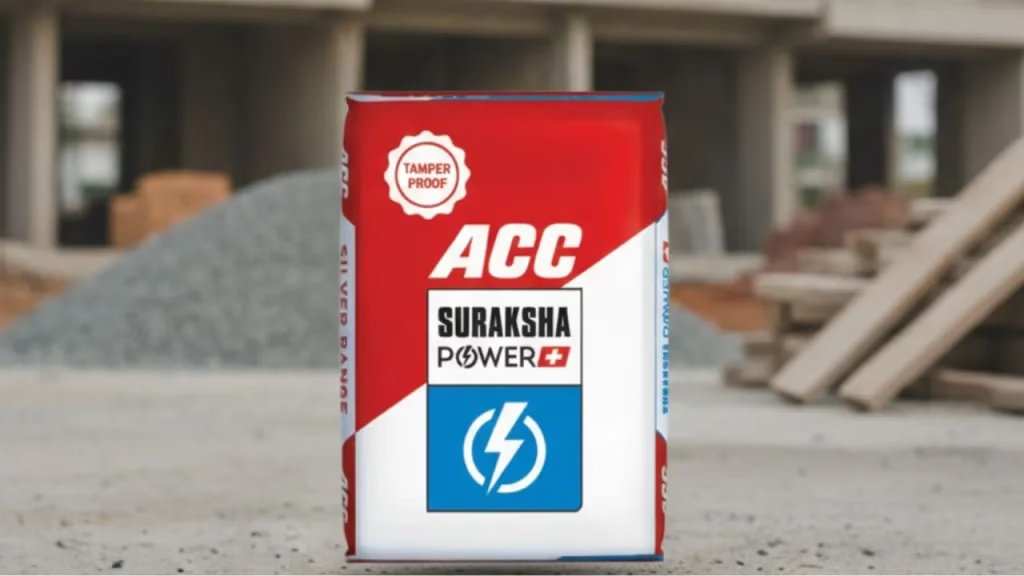
The most popular ACC variant for residential construction across South India. Suraksha is a PPC — it blends fly ash with OPC clinker, reducing heat of hydration, improving workability, and producing denser concrete that resists moisture better over time.
The name “Suraksha” (meaning protection in Hindi) reflects its key property — it builds a protective, dense concrete matrix that is particularly suited to Karnataka’s high-rainfall climate.
Best for: Foundation concrete, roof slabs, brick masonry, internal and external plastering, and general residential construction.
Price in Mysore (September 2026): ₹385 – ₹415 per 50kg bag from authorised dealers.
ACC Suraksha Power Plus
An upgraded variant of Suraksha using ACC’s Particle Size Distribution (PSD) technology — essentially finer grinding that produces a denser, more uniform cement. It offers slightly better long-term strength and better moisture resistance than standard Suraksha.
For most Mysore residential homes, standard Suraksha performs excellently. Suraksha Power Plus is worth specifying if your plot is in a high-moisture area — near a water body, in a low-lying zone prone to flooding, or on black cotton soil with high groundwater.
Price in Mysore (September 2026): ₹400 – ₹430 per 50kg bag.
ACC Gold
ACC Gold is a premium water-resistant PPC — its cement chemistry includes water-repellent compounds that make it significantly more resistant to water ingress than standard PPC. It was originally developed for coastal construction where chloride attack is a major concern, but its water-resistance properties make it valuable in any high-rainfall area.
Mysore’s 700–900mm annual rainfall and the flat terrace construction common in the city make ACC Gold worth considering for:
- External plastering on west and south-facing elevations (the faces that take the most direct monsoon rainfall)
- Parapet wall plaster and coping
- Plinth beam and ground-floor external walls in areas with high groundwater
Price in Mysore (September 2026): ₹415 – ₹445 per 50kg bag.
ACC Super
ACC Super is a high-performance cement with micro-fine particles designed to produce dense, low-permeability concrete. It is positioned between standard Suraksha and a premium specialty product — good workability, excellent impermeability, and suitable for residential construction where moisture resistance is a priority.
For most Mysore homeowners, ACC Suraksha PPC is the practical choice. ACC Super is worth considering for ground-floor slabs and retaining walls in plots with known drainage issues.
Price in Mysore (September 2026): ₹405 – ₹435 per 50kg bag.
ACC HP (High Performance)
ACC HP is a specialised engineering cement designed for dense, corrosion-resistant concrete. It is used in infrastructure, bridges, and heavy commercial construction — not standard residential homes. You will rarely encounter a recommendation for ACC HP in a residential project unless there is a specific structural engineer requirement.
Stage-by-Stage Guide — Which ACC for Each Part of Your Home
Foundation
Use: ACC Suraksha PPC
Your foundation is in contact with soil moisture continuously. PPC’s lower heat of hydration and denser concrete matrix resist water ingress far better than OPC. For Mysore’s laterite soil — which retains moisture for days after rain — the moisture resistance of Suraksha PPC is particularly valuable.
If your plot has black cotton soil, high groundwater, or sits near a water body, consider ACC Suraksha Power Plus or ACC Super for the foundation concrete.
Concrete grade: M20 minimum. M25 recommended for all foundation elements.
RCC Columns
Use: ACC OPC 53
Columns are the primary load-bearing elements of your home. They need to reach working strength quickly so construction can progress floor by floor. ACC OPC 53 reaches approximately 70% of its design strength within 7 days, allowing formwork removal and the next stage to begin.
Concrete grade: M20 minimum. M25 for G+1 and above. M30 if your structural engineer specifies it for multi-storey construction.
Curing: mandatory for 14 days minimum after casting. OPC 53 generates more heat than PPC — your site engineer must ensure adequate water curing to prevent surface cracking.
RCC Beams
Use: ACC OPC 53
Same reason as columns — beams transfer loads from slabs to columns and need to achieve design strength before the slab above is loaded. Use the same grade as the columns and cast in the same pour wherever possible, for consistency.
Roof Slab (Lanter)
Use: ACC Suraksha PPC (if timeline allows 14 days) or ACC OPC 53 (if fast deshuttering needed)
Mysore’s flat residential roofs face Karnataka monsoon rain directly. A roof slab cast with Suraksha PPC produces denser, more water-resistant concrete than OPC — which translates directly to fewer terrace leaks over the life of the building.
The trade-off: PPC requires formwork to remain for 14 days before the slab can safely carry its own weight, versus 7–10 days for OPC 53. If your contractor needs to deshutter faster, use OPC 53 with a full 21-day water curing regime after deshuttering.
Brick Masonry and AAC Block Work
Use: ACC Suraksha PPC
PPC mortar is more workable than OPC mortar — it flows more easily into joints between bricks, bonds more completely, and produces fewer shrinkage cracks at joints over time. OPC 53 for masonry is over-specified and more expensive for no benefit.
Mix ratio: 1 part cement : 5 to 6 parts sand for standard brick masonry.
Internal Plastering
Use: ACC Suraksha PPC
Suraksha PPC has lower shrinkage during curing than OPC, producing fewer hairline cracks on large flat interior wall surfaces. This is one of the most commonly seen misapplications on Mysore construction sites — contractors use whatever cement is available on site rather than specifying PPC specifically for plasterwork.
Mix ratio: 1:4 or 1:6 cement:sand depending on the base surface.
External Plastering
Use: ACC Suraksha PPC or ACC Gold
External walls face Mysore’s monsoon rainfall directly. Standard Suraksha PPC outperforms OPC on moisture resistance. For west and south-facing external walls that receive the heaviest direct rainfall, ACC Gold’s additional water-repellent compounds are worth the ₹20–30 per bag premium.
Plinth Beam and Ground-Floor External Walls
Use: ACC Suraksha PPC or ACC Gold
The plinth beam sits at ground level, in constant contact with soil moisture. Ground-floor external walls face both rainfall from above and capillary moisture from the ground. Suraksha PPC handles moderate moisture conditions well. Where the plot has high groundwater, a drainage problem, or is on expansive soil, use ACC Gold for this zone.
ACC Suraksha vs ACC Gold — When Does Gold Actually Make Sense?
This is the most common question homeowners ask about the ACC range. The practical answer:
Use standard ACC Suraksha PPC for 85–90% of your home — columns (with OPC 53), beams, roof slab, masonry, and internal plastering. Suraksha is excellent for all of these.
Upgrade to ACC Gold for external plastering on rain-exposed elevations, parapet wall plaster, plinth beam and ground-floor external walls in high-moisture plots, and any below-grade concrete in areas with groundwater. The ₹25–35 per bag premium is justified in these specific applications.
Do not use ACC Gold for everything — the water-repellent compound in Gold does not provide any additional benefit for internal plastering, masonry mortar, or structural RCC elements. You would be paying the premium for no practical gain.
ACC vs UltraTech — Which Is Better for House Construction in Mysore?
This is one of the most searched cement comparisons in Karnataka.
| Factor | ACC | UltraTech |
|---|---|---|
| History in India | Since 1936 — oldest major brand | 2004 (merger of L&T and Grasim cement) |
| OPC 53 quality | Excellent — consistent BIS certification | Excellent — market leader |
| PPC quality (Suraksha vs UltraTech PPC) | Excellent | Excellent |
| Price (OPC 53, Mysore Sep 2026) | ₹400–₹430/bag | ₹425–₹450/bag |
| Price (PPC, Mysore Sep 2026) | ₹385–₹415/bag | ₹395–₹425/bag |
| Karnataka supply chain | Good — Wadi (Karnataka) plant nearby | Very strong — multiple Karnataka plants |
| Authorised dealer network in Mysore | Good | Excellent |
| Contractor preference in Mysore | Both widely accepted | Slightly more commonly specified |
Verdict for Mysore homeowners: ACC is marginally cheaper per bag than UltraTech in most Mysore markets — ₹15–30 per bag less depending on variant. On a full house requiring 400–600 bags, that is ₹6,000–₹18,000 in savings. ACC’s quality is on par with UltraTech grade for grade — both are BIS-certified and well-manufactured.
The practical choice: use whichever brand’s authorised dealer in Mysore can supply fresh stock (under 3 months old from manufacturing date) at a competitive price. Brand preference between ACC and UltraTech matters far less than freshness, correct grade selection, and proper site supervision.
ACC Cement Prices in Mysore — September 2026
| ACC Variant | Grade | Price Per 50kg Bag (Mysore, Sep 2026) |
|---|---|---|
| ACC OPC 53 | OPC 53 | ₹400 – ₹430 |
| ACC Suraksha PPC | PPC | ₹385 – ₹415 |
| ACC Suraksha Power Plus | PPC (premium) | ₹400 – ₹430 |
| ACC Gold | PPC (water-resistant) | ₹415 – ₹445 |
| ACC Super | High Performance PPC | ₹405 – ₹435 |
Bulk discount: For orders above 100 bags, most authorised ACC dealers in Mysore offer ₹10–₹20 per bag discount. For a full house order (400–600 bags), negotiate a project rate directly with the dealer and ask for delivery in batches as required — this keeps the cement fresher on site.
Buying rule: Always check the manufacturing date on every bag. Never accept bags older than 3 months. Cement loses approximately 20% of its strength after 3 months of storage. No cement brand maintains quality in a poorly ventilated godown for 6 months — the bag is the same, the cement is not.
How Many ACC Cement Bags for a House in Mysore?
| Home Size | Configuration | Cement Required | Approx. Cost (Suraksha PPC) |
|---|---|---|---|
| 20×30 plot | G (ground floor) | 200–260 bags | ₹77,000 – ₹1,08,000 |
| 30×40 plot | G (ground floor) | 320–400 bags | ₹1,23,000 – ₹1,66,000 |
| 30×40 plot | G+1 duplex | 550–700 bags | ₹2,12,000 – ₹2,91,000 |
| 40×60 plot | G+1 | 800–1,000 bags | ₹3,08,000 – ₹4,15,000 |
These are estimates for the full build — foundation, structure, masonry, and plastering combined. Your structural engineer’s Bill of Quantities gives the exact figure. Always add 5–7% for wastage.
How to Check If ACC Cement Is Genuine
Manufacturing date on every bag — the most important check. Printed on the bag, typically on a coloured strip near the top. Never accept bags with no visible date or dates older than 3 months.
BIS mark and IS number — every genuine ACC bag carries the ISI mark with the relevant IS number (IS 269:2015 for OPC, IS 1489:2015 for PPC). The mark should be clearly printed and legible.
Free-flowing powder — open a bag and feel the cement. It should be completely free-flowing and powdery with no lumps. Any lumps — however small — indicate moisture absorption and partial hydration, which means the cement has lost strength.
Consistent colour — ACC Suraksha is grey. ACC Gold has a slightly different shade reflecting its composition. Significant colour variation within the same batch from the same dealer warrants investigation.
Authorised dealer only — verify on the ACC website or through their dealer helpline. Authorised dealers are accountable for product quality and freshness. Unverified sources are not.
Frequently Asked Questions
ACC Suraksha PPC is the best all-round choice for most residential construction in India. It offers better workability, lower heat of hydration, and denser long-term concrete than OPC — making it ideal for foundations, slabs, masonry, and plastering. For structural RCC elements like columns and beams where early strength matters, use ACC OPC 53. For water-exposed external elements in high-rainfall areas like Mysore, ACC Gold is a worthwhile upgrade.
ACC Suraksha is a general-purpose Portland Pozzolana Cement (PPC) suitable for all residential construction applications. ACC Gold is a premium water-resistant variant of PPC that incorporates water-repellent compounds in its formulation — making it more resistant to moisture ingress. Gold costs ₹25–35 per bag more than Suraksha and is worth specifying for external plastering on rain-exposed walls, plinth beam plaster, and any below-grade application in high-moisture plots. For internal plastering and structural concrete, standard Suraksha is adequate.
Both are premium, BIS-certified brands with comparable quality grade for grade. ACC is typically ₹15–30 per bag cheaper than UltraTech in Mysore markets. The more important factors than brand are: correct grade selection (OPC 53 vs PPC for the right application), freshness (under 3 months from manufacturing), and site supervision quality. A well-supervised build using ACC Suraksha will outperform a poorly supervised build using UltraTech OPC 53
At Zenith Constructions Mysore, we specify ACC OPC 53 for all RCC structural elements and ACC Suraksha PPC for masonry, plastering, and foundation work on projects where ACC is the preferred brand. All cement is procured from authorised dealers with manufacturing date verification. Contact us for a free consultation on your Mysore home.
Related guides:
- Which UltraTech Cement Is Best for House Construction?
- Best Cement for Slab Casting in India 2026
- Which Cement Is Best for House Construction?
- Best Sariya (TMT Bar) for Home Construction 2026
- Civil Contractors in Mysore — What They Do and What They Charge
- House Construction Cost in Mysore 2026 — Complete Guide