Every monsoon, the same conversation happens across Mysore. A homeowner notices a damp patch on the bedroom ceiling. Then a brown stain spreads. Then paint starts peeling off the wall in sheets. Then they call a contractor, get a quote, and find out that fixing a waterproofing failure costs three to ten times more than getting it right the first time.
Waterproofing is the part of house construction that nobody thinks about until it fails — and by the time it fails, water has usually been travelling through the structure for weeks or months before it becomes visible.
This guide covers everything a Mysore homeowner needs to know: why houses in Mysore leak, which waterproofing method works for which part of the house, what it costs in 2026, and what to do if you already have a leak.
Why Mysore Homes Are Particularly Vulnerable to Water Damage
Mysore receives 700–900mm of rainfall annually, concentrated in the June–October monsoon. The city’s flat residential roofing, laterite soil conditions, and the rapid construction pace of most residential projects create a specific set of waterproofing risks that are worth understanding before we talk about solutions.
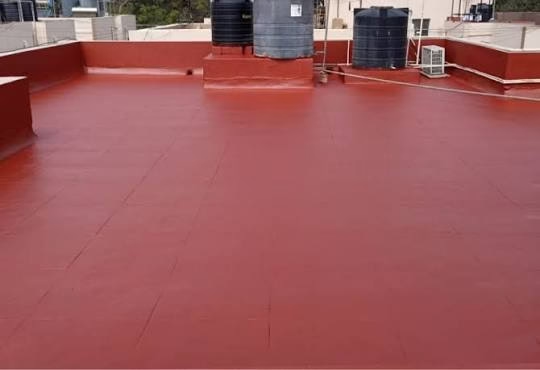
Flat terraces accumulate standing water. Unlike pitched roofs that shed water immediately, the flat RCC roofs common in Mysore can hold 50–200 litres of water after heavy rain. Every minute that water sits on the slab, it is looking for a crack, a cold joint, or a poorly sealed parapet wall junction to enter through.
Laterite soil holds moisture. Mysore’s characteristic red laterite soil is porous and retains water for days after rain. Foundations and plinth beams in contact with this soil are under constant capillary moisture pressure — which is why basement-level dampness and ground-floor wall moisture are common complaints in Mysore homes built without adequate plinth waterproofing.
Construction speed creates cold joints. When concrete is poured in stages — as almost all residential construction is — the joint between the old and new concrete is called a cold joint. These are natural weak points where water finds entry. In rapidly built homes where staging intervals are rushed, cold joints are more numerous and more vulnerable.
Poor-quality waterproofing at construction stage is invisible for 1–3 years. A contractor who applies only one coat instead of two, skips the primer, or uses paint instead of waterproofing membrane will produce a surface that looks identical to a properly waterproofed surface the day it is done. The failure appears 18–36 months later — after the builder has been paid, the defects liability period has lapsed, and the homeowner bears the full cost.
The Most Important Fact About Waterproofing
Waterproofing done during construction costs 1–2% of the total build cost. Retrofitting failed waterproofing costs 10–15 times more — because you have to break tiles, remove plaster, redo the treatment, replaster, and re-tile. A bathroom that costs ₹6,000–₹10,000 to waterproof during construction costs ₹60,000–₹1,50,000 to fix properly after the tiles have gone on.
This is not a minor cost optimisation. It is one of the most consequential decisions in any residential construction project.
Waterproofing Cost in Mysore — 2026 Rates
Mysore waterproofing costs run approximately 10–15% lower than Bengaluru rates for equivalent treatments, due to lower labour costs.
Terrace Waterproofing Cost
| Method | Cost Per Sqft (Mysore) | Lifespan | Best For |
|---|---|---|---|
| Cementitious coating (basic) | ₹25 – ₹45 | 5–7 years | Budget, accessible terraces |
| Polymer-modified coating | ₹40 – ₹65 | 8–10 years | Most residential homes |
| APP bituminous membrane | ₹70 – ₹110 | 12–15 years | High-exposure terraces |
| PU (polyurethane) liquid membrane | ₹90 – ₹150 | 15–20 years | Premium, traffic-bearing terraces |
| Brick-bat coba (traditional) | ₹55 – ₹85 | 10–15 years | Well-suited to Mysore climate |
For a standard 30×40 terrace (approx. 900 sqft) in Mysore:
- Basic cementitious: ₹22,500 – ₹40,500
- Polymer-modified: ₹36,000 – ₹58,500
- APP membrane: ₹63,000 – ₹99,000
- PU membrane: ₹81,000 – ₹1,35,000
Bathroom Waterproofing Cost
Bathroom waterproofing is priced per bathroom in most cases because floor area alone doesn’t capture the wall treatment involved.
| Method | Cost Per Bathroom (Mysore) | Coverage |
|---|---|---|
| Cementitious coating only | ₹3,500 – ₹6,000 | Floor + walls to 300mm |
| Two-layer system (cement + membrane) | ₹6,000 – ₹10,000 | Floor + walls to 1.8m |
| Full waterproofing with sunken slab treatment | ₹10,000 – ₹18,000 | Complete treatment |
Other Waterproofing Costs
| Area | Cost Range (Mysore 2026) |
|---|---|
| Sump / underground water tank | ₹18,000 – ₹35,000 |
| Overhead tank (internal) | ₹5,000 – ₹12,000 |
| External walls (full building) | ₹25 – ₹55 per sqft |
| Basement / plinth area | ₹60 – ₹120 per sqft |
| Terrace parapet walls | ₹180 – ₹350 per running metre |
Terrace Waterproofing — The Most Critical Zone
The terrace is where most Mysore homeowners discover their waterproofing problem first. A brown stain on the top-floor bedroom ceiling is almost always a terrace waterproofing failure, not a plumbing leak.
How Terrace Waterproofing Fails
Junction failures at parapets. The joint between the flat slab and the upstanding parapet wall is the single most common entry point for terrace water. This junction cracks due to thermal movement — the slab expands and contracts with temperature changes, and the bond between slab and parapet breaks over time if not properly treated with a flexible sealant or membrane that accommodates movement.
Inadequate slope. Every terrace must slope toward a drain at 1:50 minimum — meaning for every 50cm of horizontal distance, the slab drops 1cm toward the outlet. A flat terrace with no slope allows water to pond, dramatically increasing the pressure and time that water has to find a path downward.
Pipe penetrations not sealed. Every pipe, bolt, or vent that passes through the terrace slab is a potential entry point. Properly waterproofed penetrations use a collar system with flexible sealant. Poorly done penetrations use only cement, which cracks within 2–3 monsoons.
Single coat applied instead of two. Most reputable waterproofing systems require a minimum of two coats — primer, first waterproofing coat, second waterproofing coat. Contractors cutting corners apply one thin coat. This saves 30–40% of material cost and typically fails within 3–5 years.
Which Terrace Waterproofing Method Is Right for Mysore
Brick-bat coba — the traditional South Indian method — remains highly effective and well-suited to Mysore’s climate. A layer of broken bricks is set in a lime-cement mortar bed over the structural slab, creating a thick insulating layer that reduces heat transfer to the living spaces below while shedding water effectively. Cost-effective, easy to repair, and long-lasting when done well. This is what most experienced Mysore builders use for residential homes.
Polymer-modified cementitious waterproofing — the most common modern method for residential terraces. A polymer additive is mixed into the cement slurry, creating a flexible coating that can accommodate minor structural movement without cracking. Good lifespan (8–10 years), easy to apply, and widely available in Mysore through brands like Dr. Fixit, Fosroc, and Pidilite.
APP bituminous membrane — torch-applied sheets of modified bitumen that form a continuous waterproof layer over the slab. Excellent long-term performance (12–15 years), particularly good at bridging minor cracks. More expensive than cementitious systems and requires skilled application — the torch work must be done by a trained applicator.
PU liquid membrane — the premium option for high-traffic terraces or terraces used as garden or recreation space. Applied as a liquid that cures to a seamless rubber-like membrane. Longest lifespan, most expensive, requires the most careful surface preparation.
For most standard residential homes in Mysore: polymer-modified cementitious waterproofing or brick-bat coba is the appropriate choice. PU membrane is rarely necessary for a simple flat residential terrace.
Bathroom Waterproofing — Done Right Once
Bathrooms are the source of more water damage claims in Indian homes than any other room. The reason is consistent: waterproofing is either skipped entirely, done after tiling instead of before, or applied as a single coat instead of two layers.
The Two-Layer System
Correct bathroom waterproofing is a two-layer system applied before any tiling begins:
Layer 1 — Cementitious or acrylic chemical coating across the entire bathroom floor and up all walls to a minimum height of 1.8 metres. This provides the primary waterproofing barrier and must be applied in two coats with adequate drying time between coats.
Layer 2 — APP or polymer membrane in the shower zone — the highest-risk area where water contact is continuous. This second membrane is applied over the first chemical coat and provides redundant protection at the point of greatest exposure.
The flood test — after both layers are applied and cured, the bathroom is plugged and filled with 25–50mm of water for 24–48 hours. Any leakage through the ceiling of the room below confirms a failure that must be fixed before tiling. This test is non-negotiable for a professionally done bathroom waterproofing. Never accept bathroom waterproofing without a flood test.
The Junction Problem
Approximately 80% of bathroom leakage in Indian homes starts at junctions — the joint between floor and wall, between the sunken slab and the structural beam at its edge, and around pipe penetrations. These junctions are movement points. The floor and wall expand and contract slightly with temperature changes, and any waterproofing that does not accommodate this movement will crack at the joint.
Correct treatment: apply a flexible joint filler (polyurethane sealant or elastomeric compound) into the floor-wall junction before applying the waterproofing membrane, creating a coved corner that the membrane can bridge without cracking.
Sump and Water Tank Waterproofing
Every Mysore home has an underground sump — and most have an overhead tank. Both hold water 365 days a year and are in constant contact with soil moisture. Proper waterproofing is essential for two reasons: to prevent drinking water from being contaminated by soil infiltration, and to prevent the sump walls from deteriorating.
For new sumps: crystalline waterproofing is the most effective method. A crystalline compound (brands like Xypex, Dr. Fixit Krystal) is mixed into the concrete or applied as a surface coating. It reacts chemically with water to form crystals that fill capillary pores — and uniquely, if the structure cracks and water contacts the coating again, the crystalline reaction reactivates and self-heals the crack. Ideal for below-ground water-retaining structures.
Cost in Mysore: ₹18,000 – ₹35,000 for a standard 5,000-litre sump, including waterproofing material and labour.
For existing leaking sumps: drain and dry the sump completely before treating. Apply a crystalline coating to the interior face of all walls and the floor. Allow to cure for 7 days before refilling. If cracks are visible, chase and repair them before coating.
External Wall Waterproofing
External walls in Mysore face direct monsoon rainfall, particularly on the west and south-facing elevations. Water penetrates through cracks in the plaster, through the plaster-masonry interface, and through poorly sealed door and window frames.
Signs of external wall moisture failure: white efflorescence (salt deposits) on the exterior face, damp patches on interior walls corresponding to the exterior rain exposure, paint peeling from interior walls on the side facing heavy rain.
Treatment:
- Remove all loose plaster and paint from affected areas
- Fill all cracks with polymer-modified cement mortar
- Apply a waterproof plaster coat (PPC cement with waterproofing admixture, 15mm thick)
- Apply exterior waterproof coating — acrylic-based or elastomeric paint specifically rated for exterior waterproofing
Cost in Mysore: ₹25 – ₹55 per sqft for external wall waterproofing treatment, depending on the extent of existing damage and the product used.
Window and door frame sealing — one of the most overlooked waterproofing tasks. Every window frame is a potential entry point where the frame meets the masonry. Use a polyurethane or silicone sealant at this joint and reapply every 5–7 years.
How to Tell Good Waterproofing from Bad
When a contractor has completed waterproofing work on your home, these are the checks that separate proper work from cutting corners:
Terrace:
- The surface should show no pinholes or uncoated patches when you look closely
- The slope should be visible — water placed on the terrace should run toward the drain
- Parapet wall junctions should have a coved (curved) transition, not a sharp 90-degree angle
- Ask for the product batch number and data sheet — a legitimate contractor uses named products with documented specifications
Bathroom:
- Insist on a 24-hour flood test before any tiling begins — this is your only chance to catch a failure
- The coating should extend to 1.8 metres on all walls, not just 300mm
- Floor-wall junctions should have a cove fillet, not a sharp corner
- Two coats should be visible (you can check the application log or ask the contractor)
Sump:
- The interior surface should have a smooth, consistent crystalline or polymer coating with no visible dry spots
- Conduct a water retention test — fill the sump and mark the water level. Check after 48 hours for any unexplained drop
DIY vs Professional Waterproofing — When Each Makes Sense
DIY is appropriate for:
- Hairline crack sealing on external walls using a surface crack filler
- Reapplying waterproof exterior paint on already-sound external walls
- Overhead tank interior recoating with a brush-applied crystalline compound
Call a professional for:
- Any terrace waterproofing — the slope, junction treatment, and membrane application require skill and equipment
- Bathroom waterproofing before tiling — errors here are irreversible without demolishing the bathroom
- Sump waterproofing — confined space, crystalline chemistry, and structural cracks require professional assessment
- Any active leak in a finished home — finding the actual source of a leak in a finished building requires diagnostic skill that most homeowners don’t have
The waterproofing market in Mysore has many small contractors alongside established companies. For significant work, ask for the product brand they use (Dr. Fixit, Fosroc, Pidilite, Asian Paints Damp Proof, or Xypex are reputable), request a written warranty of at least 5 years, and verify that they conduct the appropriate quality test (flood test for bathrooms, water test for sump) before considering the job complete.
When You Already Have a Leak — What to Do Right Now
Step 1 — Find the actual source, not the visible symptom. A damp patch on a ground-floor bedroom wall may be caused by a terrace leak on the floor above, a plumbing leak inside the wall, or rising damp from the plinth. Each has a different solution. Treating the symptom without identifying the source wastes money. If you are unsure, have a professional trace the leak before committing to a repair method.
Step 2 — Stop active water entry first. During monsoon, use a temporary hydrophilic or rapid-setting cement plug to stop active water flow before attempting any waterproofing treatment. Waterproofing applied to a wet or actively leaking surface will fail.
Step 3 — Dry the affected area completely before treatment. Most waterproofing products require the substrate to be dry or only slightly damp. Applying membrane to a wet surface traps moisture and dramatically reduces adhesion and lifespan.
Step 4 — Treat the source, not just the damage. If a terrace leak has damaged the ceiling, fix the terrace waterproofing first. Patch the ceiling after you seal the source. Doing it the other way around means redoing the ceiling repair once the terrace work inevitably disturbs the area.
Step 5 — Budget for full repair, not patches. Spot-treating a waterproofing failure is rarely the right answer. If your terrace coating has failed in one area, it has almost certainly degraded in other areas too — the spot you patched will hold while the next weak point fails in the following monsoon. A complete re-treatment is more cost-effective than annual patches.
Zenith Construction’s Waterproofing Standard
Every home built by Zenith Constructions in Mysore includes:
Terrace: Polymer-modified cementitious waterproofing with brick-bat coba or APP membrane, applied in two coats with adequate curing between coats. Parapet junctions treated with elastomeric filler and coved corner. Proper slope verified before treatment.
Bathrooms: Two-layer waterproofing system — cementitious coat to 1.8m height plus APP membrane in shower zones — applied before tiling, with a 24-hour flood test as a mandatory quality gate.
Sump: Crystalline waterproofing on all interior surfaces, applied in two coats. Water retention test before backfilling.
Overhead tank: Polymer-modified coating on interior surfaces.
All waterproofing work is supervised by our site engineer and documented. We use Dr. Fixit, Fosroc, or Pidilite products exclusively — no unbranded or unknown-source waterproofing materials.
Our structural defect warranty covers waterproofing failures arising from construction defects during the first 12 months after handover. Contact us if you are building a home in Mysore or have an existing waterproofing issue you need assessed.
Frequently Asked Questions
Terrace waterproofing in Mysore costs ₹25–₹45 per sqft for a basic cementitious system and ₹70–₹110 per sqft for an APP bituminous membrane. For a standard 30×40 home terrace (approximately 900 sqft), expect ₹22,000–₹45,000 for polymer-modified waterproofing or ₹63,000–₹99,000 for an APP membrane system. Mysore rates run approximately 10–15% lower than Bengaluru for equivalent treatments.
Lifespan depends on the method. A polymer-modified cementitious coating lasts 8–10 years with proper application. An APP bituminous membrane lasts 12–15 years. A PU liquid membrane can last 15–20 years. Brick-bat coba, if well done, lasts 10–15 years. All methods require correct slope, proper junction treatment, and quality application to achieve their rated lifespan. Poor application of any system can fail within 2–3 years.
Can I do terrace waterproofing during monsoon in Mysore?
Waterproofing should ideally be done on a dry surface. During heavy rain, the surface cannot be adequately prepared or allowed to dry before treatment. For new construction, terrace waterproofing should be done before the monsoon begins — ideally February to May. For retrofit work on a leaking terrace, temporary patching can be done during monsoon, but full re-treatment should wait until the surface can be properly dried (October–November in Mysore).
What is the best waterproofing method for bathrooms in Mysore?
A two-layer system — cementitious waterproofing coat applied to the full floor and walls up to 1.8m, followed by an APP or polymer membrane in the shower zone — is the correct method. This must be applied before tiling. The job should always be verified with a 24–48 hour flood test before tiling proceeds. Applying waterproofing after tiling is ineffective and means any failure requires demolishing the bathroom to fix.
What causes most waterproofing failures in Mysore homes?
The four most common causes are: inadequate junction treatment at parapet walls and floor-wall corners; single coat applied instead of the specified two; no slope on the terrace allowing water to pond; and waterproofing applied to a damp or dirty surface, reducing adhesion. These are all contractor execution failures rather than product failures — which is why supervision and quality testing matter more than brand selection for waterproofing work.
Related guides: