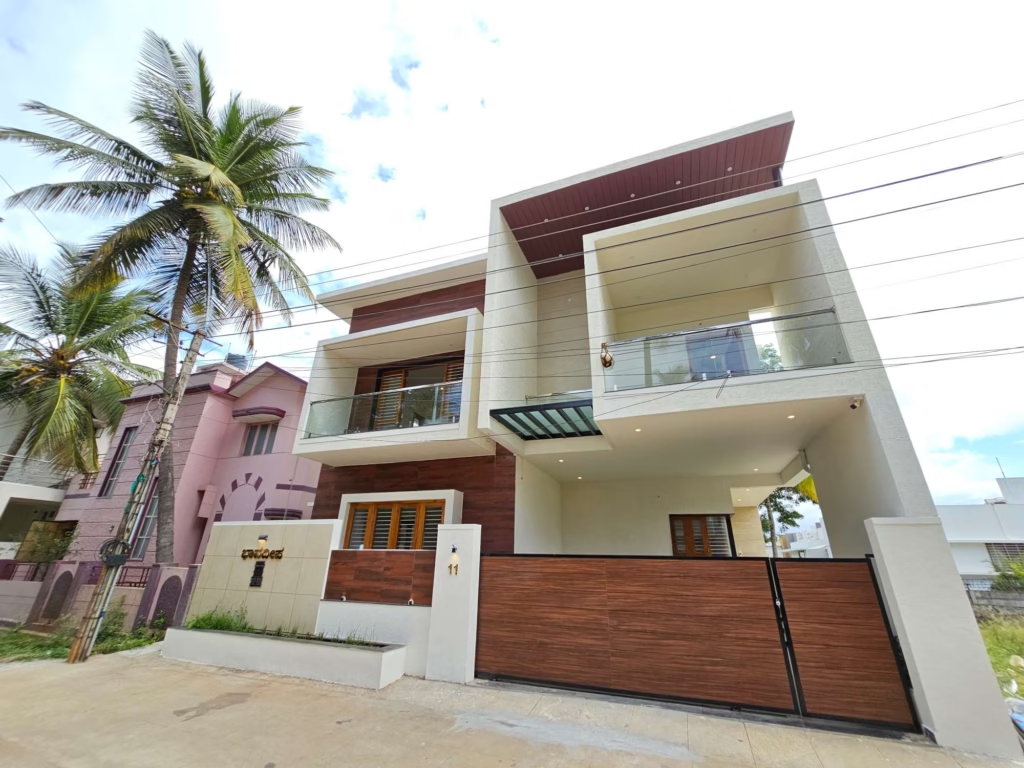
Mysore is no longer just a heritage city. The Bengaluru–Mysuru Expressway has transformed it into one of Karnataka’s fastest-growing commercial corridors. New retail spaces, IT office parks, warehouses, hotels, and mixed-use developments are coming up across Hebbal, the Ring Road belt, Hootagalli industrial area, and the city centre — at a pace the city has not seen before.
If you own a commercial plot in Mysore or are planning a business property investment, understanding the different types of commercial buildings — what each involves, what they cost to build, and what regulations apply — is the starting point for every good project decision.

This guide covers every major commercial building type in Mysore in 2026 with realistic construction cost ranges, MUDA regulation notes, and the specific factors that drive costs up or down for each type.
What Counts as a Commercial Building in Mysore?
Under MUDA (Mysore Urban Development Authority) zoning regulations and the Karnataka Town and Country Planning Act, a commercial building is any structure built primarily for business, trade, service, or income-generating activity — as opposed to residential use.
Commercial buildings in Mysore are subject to different zoning rules, FAR (Floor Area Ratio) allowances, setback requirements, and approval fees compared to residential buildings. The type of commercial use — retail, office, industrial, hospitality — determines which zone your plot must be in, how high you can build, and what parking provisions you must include.
The average cost of commercial construction in India ranges between ₹1,500 and ₹3,500 per sqft depending on the city, material quality, and type of building. In Mysore specifically, as a tier-2 city with lower labour costs than Bengaluru, commercial construction runs approximately 15–25% more cost-efficient than Bengaluru rates for equivalent quality.
Retail Commercial Buildings
Retail buildings are the most common type of commercial construction in Mysore. They include shops, showrooms, shopping complexes, supermarkets, and standalone retail units.
Types of Retail Buildings
Standalone shops and ground-floor retail units The most common commercial construction in Mysore. A single ground-floor or G+1 unit on a commercial plot, typically on a main road — Sayyaji Rao Road, Hunsur Road, Nazarbad Main Road, or the Ring Road. These are built for lease or self-use.
Neighbourhood shopping complexes A cluster of 6–20 shops in a single building, typically on a 40×60 to 60×80 plot. Multiple tenants, single ownership. Common in growing residential areas — Bogadi, Hebbal, Hootagalli — where new residential demand creates retail catchment.
Large-format showrooms Single-tenant buildings of 3,000–15,000 sqft built for automobile showrooms, furniture retailers, electronics chains, or appliance brands. Require large frontage, high floor-to-ceiling height (minimum 14–16 ft), and significant parking.
Shopping malls Multi-anchor, multi-level retail complexes. Rare in Mysore outside of established developments like Forum Mysore or the Metropolis area. High engineering complexity, significant MUDA compliance requirements.
Retail Building Construction Costs in Mysore 2026
| Retail Type | Built-up Area | Construction Cost/sqft | Total Construction Cost |
|---|---|---|---|
| Single ground-floor shop | 200–500 sqft | ₹1,800–₹2,200 | ₹3.6L–₹11L |
| Ground + mezzanine retail | 400–800 sqft | ₹2,000–₹2,400 | ₹8L–₹19.2L |
| Small shopping complex (8–12 shops) | 3,000–6,000 sqft | ₹2,200–₹2,800 | ₹66L–₹1.68Cr |
| Large showroom (auto/furniture) | 5,000–15,000 sqft | ₹2,500–₹3,200 | ₹1.25Cr–₹4.8Cr |
| Boutique mall / retail plaza | 15,000+ sqft | ₹3,000–₹4,500 | ₹4.5Cr+ |
What drives retail construction costs up:
- High floor-to-ceiling height (above 12 ft) — structural engineering cost increases
- Large glass frontage — curtain wall systems are expensive
- Central air conditioning provisions — MEP engineering adds 8–12% to project cost
- Underground parking — adds ₹800–₹1,200/sqft to parking areas
- Fire safety compliance for buildings above 15 metres — mandatory sprinkler systems, fire escapes
What is typically excluded from per-sqft retail quotes: Shop fit-out (interiors for individual tenants), signage infrastructure, generator provision, lift installation, and MUDA fees and approval costs.
Office Buildings
Office construction in Mysore has grown significantly since 2022, driven by the expressway’s effect on commute times from Bengaluru, IT/ITeS expansion, and the relocation of back-office functions from expensive Bengaluru locations.
Types of Office Buildings
Small professional offices (CA, legal, medical, consulting) Single-floor or G+1 buildings of 1,000–3,000 sqft, typically in professional zones — Nazarbad, Saraswathipuram, JP Nagar. Built for owner-occupation or single-tenant lease.
Mid-size office complexes 3,000–15,000 sqft buildings with multiple floors, for IT companies, BPOs, or multi-tenant professional use. Increasingly common in the Hebbal, Hootagalli, and Ring Road corridors.
IT/ITeS campus buildings Large-format office buildings of 20,000 sqft and above for technology companies. These have specific technical requirements — raised flooring, precision air conditioning, high power backup, structured cabling — that significantly increase construction cost above standard office rates.
Co-working and flexible office spaces A growing category in Mysore, driven by remote workers and startups. The build-out is heavier than standard office — hospitality-grade common areas, meeting rooms, phone booths, café spaces — and typically costs 20–30% more than standard office construction.
Office Building Construction Costs in Mysore 2026
| Office Type | Built-up Area | Construction Cost/sqft | Total Construction Cost |
|---|---|---|---|
| Small professional office (G) | 1,000–2,000 sqft | ₹2,000–₹2,400 | ₹20L–₹48L |
| Standard office building (G+2) | 3,000–8,000 sqft | ₹2,200–₹2,800 | ₹66L–₹2.24Cr |
| Mid-size commercial complex | 8,000–20,000 sqft | ₹2,500–₹3,200 | ₹2Cr–₹6.4Cr |
| IT/ITeS office (with technical fit-out) | 15,000+ sqft | ₹3,200–₹4,500 | ₹4.8Cr–₹9Cr+ |
| Co-working space | 3,000–8,000 sqft | ₹2,800–₹3,500 | ₹84L–₹2.8Cr |
What makes office buildings more expensive than residential:
- HVAC systems for controlled environments — central air conditioning with fresh air handling
- Higher structural loads — server rooms, dense occupancy, raised flooring
- Fire safety compliance — mandatory for buildings above 15 metres
- Generator backup — typically 100% power backup for commercial use
- Lift provision — mandatory above G+3 in most MUDA commercial zones
- Parking — typically 1 space per 100 sqft of office area required
Industrial and Warehouse Buildings
Mysore has a well-established industrial base — the KIADB (Karnataka Industrial Areas Development Board) industrial areas at Hootagalli, Belagola, and the new Mysuru Industrial Area at Nanjangud Road host hundreds of manufacturing and logistics operations.
Types of Industrial Buildings
Light industrial sheds Simple steel frame or RCC frame structures of 2,000–10,000 sqft for light manufacturing, fabrication, or small-scale production. Common in Hootagalli and the peripheral industrial zones.
Warehouses and logistics hubs Large clear-span structures of 10,000–1,00,000 sqft for storage, distribution, or e-commerce fulfillment. Key features: minimum 8–10 metre clear height, heavy-duty flooring (150–200mm thick RCC slab), dock levellers, and fire suppression systems. Mysore’s expressway connectivity has made it a logistics hub for Bengaluru’s western distribution.
Manufacturing facilities Purpose-built factories with specific requirements — overhead crane provisions, acid-resistant flooring, explosion-proof electrical, heavy HVAC — depending on the industry. Cost varies enormously based on the process requirements.
Cold storage buildings Insulated structures for food, pharmaceutical, or chemical storage. Significantly more expensive than standard warehouses due to polyurethane foam insulation, refrigeration plant rooms, and vapour barriers.
Industrial and Warehouse Construction Costs in Mysore 2026
| Industrial Type | Area | Construction Cost/sqft | Total Construction Cost |
|---|---|---|---|
| Light industrial shed (steel) | 2,000–5,000 sqft | ₹1,200–₹1,800 | ₹24L–₹90L |
| Light industrial shed (RCC) | 2,000–5,000 sqft | ₹1,800–₹2,200 | ₹36L–₹1.1Cr |
| Standard warehouse | 10,000–50,000 sqft | ₹1,500–₹2,200 | ₹1.5Cr–₹11Cr |
| High-bay logistics warehouse | 20,000+ sqft | ₹2,000–₹2,800 | ₹4Cr–₹14Cr+ |
| Manufacturing facility (standard) | 5,000–20,000 sqft | ₹2,200–₹3,500 | ₹1.1Cr–₹7Cr |
| Cold storage facility | 3,000–10,000 sqft | ₹3,500–₹5,500 | ₹1.05Cr–₹5.5Cr |
Industrial construction specifics for Mysore: KIADB allotted plots in Hootagalli and Belagola have specific building line requirements and maximum ground coverage norms. Structures on KIADB land require KIADB approval in addition to MUDA/gram panchayat approval depending on the plot location.
Hospitality Buildings
Mysore’s tourism — the Mysore Palace, Chamundi Hills, Brindavan Gardens, Dasara celebrations — generates consistent demand for hospitality infrastructure. The city receives 6–7 million tourists annually, supporting a growing hotel, resort, and serviced apartment market.
Types of Hospitality Buildings
Budget hotels and lodges 10–40 room properties in city centre locations. Simple RCC construction with standard finishes. High room count relative to land area is the priority.
3-star and 4-star hotels Mid-scale properties with restaurant, conference rooms, gym, and pool. Significant MEP complexity — fire safety, multiple HVAC zones, commercial kitchen, laundry. Typically 40–100 rooms on a 1–2 acre site.
Boutique hotels and heritage properties Small-scale (10–25 room) properties with premium positioning. Higher per-room construction cost but significantly higher ADR (Average Daily Rate). Popular in areas near the Palace and Chamundi Hill.
Resorts and eco-lodges Properties on Mysore’s outskirts — Srirangapatna, Nagarhole corridor, Coorg road — targeting weekend leisure travellers from Bengaluru. Lower construction density but higher landscape and amenity spend.
Serviced apartments A growing category in Mysore for long-stay business travellers and relocating IT professionals. Combination of apartment-style living with hotel services. Lower construction cost than hotels but requires kitchenette provisions in every unit.
Hospitality Construction Costs in Mysore 2026
| Hospitality Type | Typical Size | Construction Cost/sqft | Total Construction Cost |
|---|---|---|---|
| Budget hotel / lodge (30 rooms) | 8,000–12,000 sqft | ₹2,200–₹2,800 | ₹1.76Cr–₹3.36Cr |
| 3-star hotel (50 rooms) | 20,000–35,000 sqft | ₹3,000–₹4,000 | ₹6Cr–₹14Cr |
| 4-star hotel (80 rooms) | 40,000–70,000 sqft | ₹3,800–₹5,200 | ₹15.2Cr–₹36.4Cr |
| Boutique hotel (15 rooms) | 6,000–10,000 sqft | ₹3,500–₹5,000 | ₹2.1Cr–₹5Cr |
| Resort (20 cottages) | Site-specific | ₹4,000–₹7,000 | ₹8Cr–₹20Cr+ |
| Serviced apartments (20 units) | 12,000–20,000 sqft | ₹2,800–₹3,800 | ₹3.36Cr–₹7.6Cr |
Hospitality construction note: Hotel projects above 15 metres height in Mysore require Fire NOC from the Karnataka Fire and Emergency Services department, and projects above 50 rooms typically require a separate environmental clearance. Engage a consultant experienced with hospitality-specific clearances before purchasing land for a hotel project.
Mixed-Use Buildings
Mixed-use construction is the most rapidly growing commercial category in Mysore — and for good reason. A single building that combines retail on the ground floor, offices on the middle floors, and residential on the upper floors maximises the commercial return on a single plot while serving different market segments from one structure.
Common Mixed-Use Configurations in Mysore
Retail + Residential (most common) Ground and first floor commercial shops or showrooms, upper floors residential apartments or independent units. Extremely common on main road plots — Hunsur Road, Mysore-Ooty Road, Nanjangud Road — where ground floor commercial value is high but residential demand exists above.
Office + Residential Professional offices on lower floors, residential on upper floors. Common in areas like Saraswathipuram and Kuvempunagar where professional demand and residential demand overlap.
Retail + Office + Residential (true mixed-use) Full mixed-use towers with dedicated retail, office, and residential floors. Typically on larger plots (60×80 and above) in prime zones. Requires careful MUDA zone verification — not all commercial zones permit residential above commercial.
Commercial complex with service apartments Ground-floor retail, upper-floor service apartments or rental units. Increasingly common near the Bengaluru-Mysuru expressway exit points where business travellers need short-stay accommodation near commercial areas.
Mixed-Use Construction Costs in Mysore 2026
| Configuration | Typical Plot | Approx. Built-up Area | Total Construction Cost |
|---|---|---|---|
| G commercial + G+1 residential | 30×40 | 1,800–2,200 sqft | ₹40L–₹55L |
| G+1 commercial + G+2/3 residential | 40×60 | 4,000–6,000 sqft | ₹1Cr–₹1.8Cr |
| Full mixed-use complex | 60×80 or above | 10,000–20,000 sqft | ₹2.5Cr–₹6Cr |
| Commercial + service apartments | 40×60 | 5,000–8,000 sqft | ₹1.4Cr–₹2.8Cr |
Critical note on mixed-use in Mysore: MUDA zoning determines whether mixed commercial-residential use is permitted on a given plot. Commercial zone (C1) plots typically permit ground-floor retail and upper-floor residential. Residential zone plots have restrictions on commercial use. Always verify the zone classification of your plot with MUDA before designing a mixed-use building — a design that does not match the permitted land use will not receive plan approval.
Institutional Buildings
Institutional buildings serve education, healthcare, religious, and civic functions. While not purely “commercial” in the profit-generating sense, they are constructed by private parties and follow commercial construction specifications.
Types of Institutional Buildings
Educational institutions — schools, colleges, coaching centres, skill development centres. Mysore’s growing population and educational reputation drive consistent demand.
Healthcare facilities — clinics, diagnostic centres, nursing homes, hospitals. Karnataka’s Clinical Establishments Act governs healthcare construction standards including minimum room sizes, HVAC requirements, and emergency access.
Banquet halls and convention centres — one of the fastest-growing categories in Mysore, driven by wedding and event culture. Large clear-span halls of 5,000–15,000 sqft with catering kitchen, parking, and power backup.
Religious and community buildings — temples, mosques, churches, community halls. Typically lower construction cost per sqft but with significant finishing spend on specialised elements.
Institutional Construction Costs in Mysore 2026
| Institutional Type | Construction Cost/sqft |
|---|---|
| School / coaching centre | ₹1,800 – ₹2,500 |
| Diagnostic centre / clinic | ₹2,500 – ₹3,500 |
| Nursing home (20–50 beds) | ₹3,000 – ₹4,500 |
| Banquet hall (5,000 sqft) | ₹2,200 – ₹3,000 |
| Community hall | ₹1,500 – ₹2,200 |
Commercial Building Construction Cost Summary — Mysore 2026
The average cost of commercial construction in India ranges between ₹1,500 and ₹3,500 per sqft depending on the city, material quality, and type of building. In Mysore, with its lower labour costs and good material supply chains, the effective range for most commercial projects is:
| Commercial Building Category | Cost Range/sqft (Mysore 2026) | Key Cost Driver |
|---|---|---|
| Light industrial shed | ₹1,200 – ₹1,800 | Span, height, floor slab spec |
| Small retail / shops | ₹1,800 – ₹2,400 | Frontage glazing, ceiling height |
| Standard warehouse | ₹1,500 – ₹2,200 | Floor loading, clear height |
| Office building (standard) | ₹2,200 – ₹3,200 | HVAC, fire safety, parking |
| Shopping complex | ₹2,200 – ₹2,800 | Number of units, common areas |
| Mixed-use building | ₹2,000 – ₹3,000 | Configuration, MEP complexity |
| Budget hotel | ₹2,200 – ₹2,800 | Room count, bathroom spec |
| 3-star hotel | ₹3,000 – ₹4,000 | F&B, pool, conference, HVAC |
| Manufacturing facility | ₹2,200 – ₹3,500 | Process-specific requirements |
| Banquet hall | ₹2,200 – ₹3,000 | Span, acoustics, kitchen |
These rates exclude: Land cost, MUDA/KIADB approval fees, architect and structural engineer fees, MEP consultant fees, interior fit-out, and GST at 18%.
MUDA Regulations for Commercial Construction in Mysore
Every commercial building in Mysore requires MUDA (Mysore Urban Development Authority) plan approval before construction begins. Key regulatory considerations:
Zone verification first — confirm your plot’s zone classification (C1 Commercial, C2 Commercial, Industrial, Mixed Use) before designing. The zone determines permitted uses, FAR, ground coverage, and height limits.
FAR (Floor Area Ratio) — commercial zones in Mysore typically permit higher FAR than residential zones, allowing more built-up area on the same footprint. C1 commercial zones generally permit FAR of 2.0–3.5 depending on road width.
Setbacks for commercial buildings — commercial setback requirements are different from residential. Front setbacks depend on the road width — wider roads require larger setbacks. Side and rear setbacks are also mandated.
Height limits — buildings above 15 metres require additional clearances including Fire NOC. Buildings above 30 metres require additional environmental and structural compliance.
Parking requirements — MUDA mandates parking provisions for commercial buildings: typically 1 space per 50–100 sqft of built-up area depending on use. Basement parking or stilt parking must be included in the plan.
Fire safety compliance — mandatory for commercial buildings, especially above two floors. Involves fire escapes, fire doors, sprinkler systems, alarm systems, and coordination with the Karnataka Fire Department.
For a complete guide to MUDA approvals for commercial projects in Mysore, see our MUDA Building Plan Approval guide.
How to Choose the Right Commercial Building Type for Your Plot
Choosing the right commercial building type is not just about what you want to build — it is about what your plot, zone, and market can actually support.
Step 1 — Verify the zone Your MUDA zoning certificate tells you what is permitted on your plot. Building the wrong type of commercial use on a plot not zoned for it results in plan rejection and potentially illegal construction. Zenith Construction verifies zone compliance before any commercial project design begins.
Step 2 — Analyse the catchment A retail building needs customer footfall — which requires proximity to residential density, road visibility, and access. An office building needs proximity to workforce housing and parking. A warehouse needs road width adequate for trucks. Match the building type to what the location actually supports.
Step 3 — Calculate the FAR and ground coverage Your plot’s FAR determines the maximum built-up area you can construct. A 3,000 sqft plot in a C1 zone with FAR 2.5 allows 7,500 sqft of total built-up area across all floors. Maximising FAR efficiently — with the right number of floors and configuration — determines the commercial return on your investment.
Step 4 — Model the income Different commercial building types generate different rental yields. In Mysore in 2026, commercial retail on main roads yields 6–9% per annum on construction cost. Office space yields 5–7%. Warehouse yields 7–10% in good logistics locations. Hotels generate returns based on occupancy, which depends heavily on management quality.
Step 5 — Get a professional cost estimate before committing Commercial construction costs in Mysore vary by 40–60% between the basic and premium end of each building type. Getting a detailed, itemised cost estimate from an experienced commercial contractor — before purchasing materials or signing subcontracts — prevents the most common commercial construction financial mistake: starting with an underestimated budget and running out mid-project.
Frequently Asked Questions
Commercial construction costs in India range between ₹1,500 and ₹3,500 per sqft depending on the type of building, material quality, and location. In Mysore specifically, standard commercial construction runs ₹1,800–₹2,800 per sqft for retail and office use, and ₹1,200–₹1,800 for light industrial structures. Premium office and hotel construction can reach ₹3,500–₹5,000 per sqft. These figures exclude land, approvals, and interior fit-out
Not without MUDA approval for change of use or mixed-use permission. Mysore’s zoning regulations designate specific areas for commercial activity. Building commercial structures on purely residential plots violates zoning norms and risks demolition notices. Some plots in mixed-use or transitional zones may permit limited ground-floor commercial use with residential above — but this must be confirmed with MUDA before designing
What MUDA approvals are required for a commercial building in Mysore?
Commercial buildings require a MUDA Building Plan Sanction, a Commencement Certificate, and on completion an Occupancy Certificate. Buildings above 15 metres also require a Fire NOC from the Karnataka Fire Department. KIADB industrial plots have a separate approval process through KIADB in addition to local authority approvals. See our complete MUDA approval guide for process details.
How long does it take to construct a commercial building in Mysore?
Timeline depends entirely on the size and complexity. A small retail unit (500–1,000 sqft) takes 4–6 months. A medium office building (5,000–10,000 sqft) takes 10–14 months. A hotel or large commercial complex takes 18–36 months from approval to occupancy. MUDA plan approval itself typically takes 45–90 days for commercial projects.
Does Zenith Construction handle commercial projects in Mysore?
Yes. Zenith Construction has delivered residential and commercial construction projects across Mysore — including retail complexes, office buildings, and mixed-use developments. Our in-house architects, structural engineers, and project managers handle commercial projects end-to-end, including MUDA approval coordination. Contact us for a free consultation on your commercial project.
Related guides:
- Commercial Construction Company in Mysore — Zenith Constructions
- MUDA Building Plan Approval in Mysore — Complete Process 2026
- Floor Limit Rules in Mysore for Residential and Commercial Projects
- House Construction Cost in Mysore 2026 — Complete Guide
- Civil Contractors in Mysore — What to Look for
- Builders in Mysore — Complete 2026 Guide