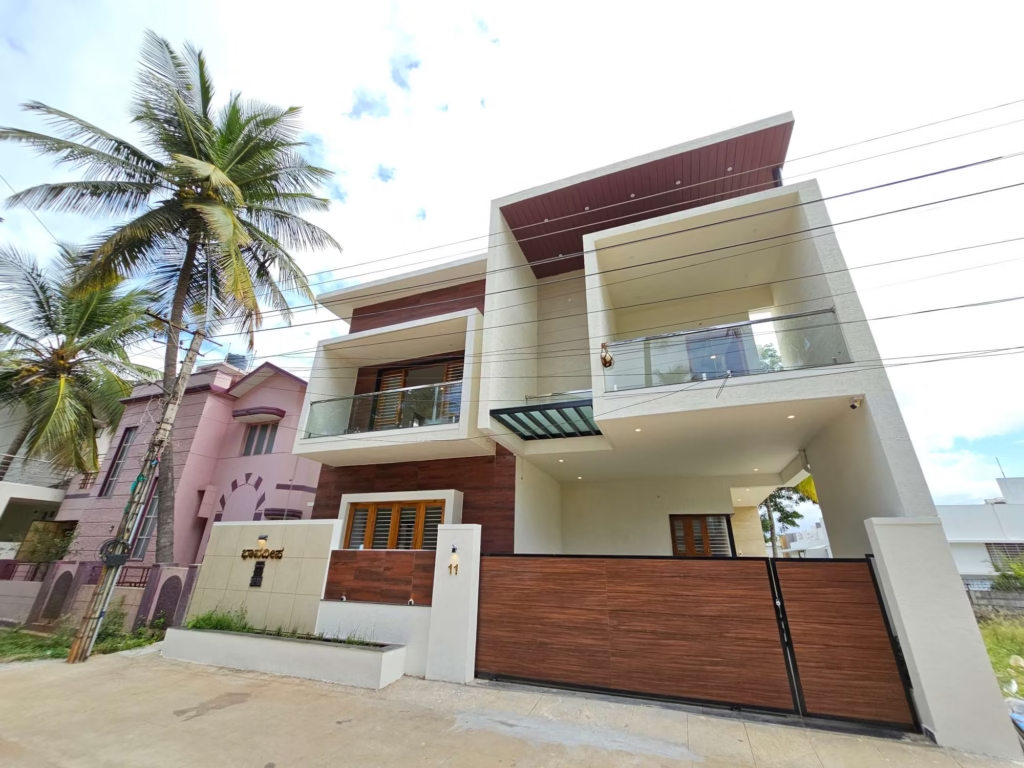
If you are building a house in Mysore or anywhere in Karnataka, you have probably seen JK Cement bags stacked at your local dealer. JK Cement is one of India’s oldest cement brands — founded in 1975 — and it remains a popular choice among contractors and builders across South India.
But JK Cement makes several different products. Walk into any hardware store and you will find JK Super Strong, JK Lakshmi Cement, JK Super Cement, JK Wall Putty, and more. Each one is formulated for a different job on site.
Choosing the wrong JK cement grade for a structural pour does not just waste money — it can compromise the strength of your columns, beams, and slabs for decades. This guide breaks down every JK Cement product, explains which one to use at each stage of construction, and gives you current Mysore prices so you can budget accurately.
JK Cement: A Quick Brand Overview
JK Cement Limited is part of the JK Organisation, one of India’s largest industrial conglomerates. The company operates multiple integrated cement plants across Rajasthan, Madhya Pradesh, and Karnataka.
Key facts relevant to builders in Mysore:
- JK Cement holds BIS certification for all its grades
- The brand has a strong dealer network in Karnataka
- JK Super Strong is the most widely used JK product among Mysore contractors
- JK Cement products are available at most major building material dealers in Hebbal Industrial Area, Bannimantap, and Vijayanagar in Mysore
JK Cement Product Range — What’s Available in 2026
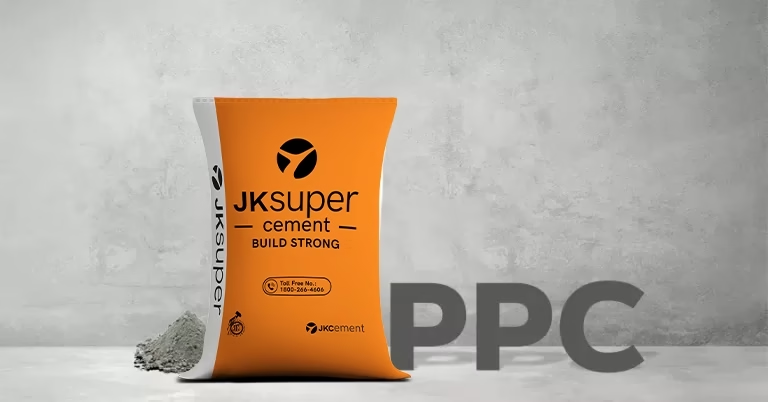
1. JK Super Strong PPC (Portland Pozzolana Cement)
Grade: PPC (IS 1489) Clinker content: ~65–70% Fly ash content: ~25–30%
JK Super Strong is JK Cement’s flagship blended cement and the most commonly available JK product in Mysore. It is a Portland Pozzolana Cement, meaning it contains fly ash as a supplementary cementitious material.
What fly ash does: Fly ash reacts slowly with calcium hydroxide released during cement hydration. This pozzolanic reaction fills micro-pores in the concrete matrix over time, making the concrete denser and more durable — but it takes longer to reach full strength compared to OPC.
Strengths of JK Super Strong PPC:
- Lower heat of hydration — reduces cracking risk in large pours
- Better workability and finish
- More resistant to sulphate attack and water penetration over time
- Slightly lower cost than OPC 53
Best used for: Foundation, slab, masonry (brick/block laying), plastering, waterproofing-sensitive areas
2. JK Super Strong OPC 53 (Ordinary Portland Cement — Grade 53)
Grade: OPC 53 (IS 269) Clinker content: ~95% 28-day compressive strength: ≥53 N/mm²
This is the high-strength structural grade. OPC 53 achieves its target strength faster than PPC because it contains very little supplementary material — it is almost pure clinker.
Strengths of JK Super Strong OPC 53:
- Fastest early strength gain — reaches 70% of 28-day strength within 7 days
- Higher ultimate compressive strength (≥53 N/mm²)
- Suitable for RCC (Reinforced Cement Concrete) structural members
- Predictable and consistent setting behaviour
Best used for: Columns, beams, staircases, compound walls — anywhere structural RCC is poured
Important: OPC 53 generates more heat during hydration. For large slab pours, this heat can cause micro-cracking. This is why experienced site engineers switch to PPC for slabs and use OPC 53 only for structural RCC elements.
3. JK Lakshmi Cement
Type: PPC / OPC (varies by product line under the Lakshmi sub-brand)
JK Lakshmi Cement is technically a separate subsidiary of the JK Group, operating its own plants and brand identity. In practice, many Mysore dealers stock both JK Super Strong and JK Lakshmi Cement products side by side.
JK Lakshmi PPC is a competitive alternative to JK Super Strong PPC — similar fly ash content, similar setting characteristics. If your dealer is out of JK Super Strong PPC and offers JK Lakshmi PPC as a substitute for masonry or plastering work, that is an acceptable swap.
4. JK Super Cement (White Cement and Wall Putty)
JK also makes JK White Cement and JK Wall Putty under its product portfolio.
- JK White Cement: Used for decorative finishes, tile grouting, and ornamental plasterwork. Not a structural cement.
- JK Wall Putty: Applied as a finishing coat over internal plaster to create a smooth, paintable surface. Not a structural cement.
Neither of these is involved in structural house construction. Do not confuse them with structural grades when placing orders.
Stage-by-Stage Guide: Which JK Cement to Use and When
Stage 1: Foundation (Footings and Plinth Beam)
Use: JK Super Strong PPC
Your foundation sits in direct contact with soil moisture. In Mysore’s red laterite soil zones (Gokulam, Hebbal, Vijayanagar), the soil can contain mild sulphate concentrations that attack pure OPC over time. PPC’s pozzolanic reaction produces a denser concrete that resists this better.
Additionally, foundation pours are often large — lots of concrete placed in a short window. PPC’s lower heat of hydration means less thermal stress and fewer micro-cracks as the concrete cures.
Pour specification: M20 grade concrete (1:1.5:3) is standard for residential footings. Use clean river sand or M-sand, well-graded 20mm aggregate, and maintain a water-cement ratio of 0.45–0.50.
Stage 2: Columns and Beams (RCC Frame)
Use: JK Super Strong OPC 53
Columns and beams are the structural skeleton of your house. They carry the full load of the floors above, the roof, and all live loads (people, furniture, water tanks). Early strength gain is critical here — you want the concrete to reach design strength quickly so formwork can be stripped and construction can proceed.
OPC 53’s 7-day strength of approximately 37 N/mm² (70% of 28-day) means shuttering can typically be removed from columns within 7 days and from beam sides within 3–4 days, keeping your construction schedule on track.
Pour specification: M25 grade concrete (1:1:2) for columns and beams in G+1 and G+2 residential construction. Use a vibrator during pour to eliminate voids. Cure with wet gunny bags or water ponding for a minimum of 14 days.
Stage 3: Roof Slab (RCC Slab)
Use: JK Super Strong PPC
The roof slab is a large, flat pour — typically 4 to 5 inches thick for residential floors. Large flat pours are particularly vulnerable to heat-induced cracking during hydration. PPC’s lower heat of hydration makes it the safer choice here.
There is a common misconception that you must use OPC 53 for slabs because “it is stronger.” This is incorrect. M20 PPC concrete meets the design strength requirement for residential slabs. The gain from using OPC 53 in a slab is marginal at best and comes with a real downside — more heat-induced micro-cracking.
Pour specification: M20 grade concrete for residential slabs up to G+1. Use M25 for G+2 and above. Cure the slab continuously for a minimum of 21 days. Water curing for 28 days is ideal and significantly improves final strength.
Stage 4: Brick and Block Masonry (Walls)
Use: JK Super Strong PPC
Mortar for brick/block laying does not need high early strength. What matters here is good bonding, workability, and consistent setting time — all qualities where PPC performs well. PPC mortar also cracks less during drying compared to OPC mortar, which is important for wall finishes applied later.
Mix ratio: 1:6 (cement:sand) for standard masonry mortar. For AAC block laying, use a thinner mortar joint (6–8mm) with the same mix ratio.
Stage 5: Plastering (Internal and External)
Use: JK Super Strong PPC
PPC is the go-to for all plastering work. It provides good workability, adheres well to masonry surfaces, and its slower strength gain means the plaster does not crack during the initial drying period.
Internal plaster mix: 1:6 (cement:sand), 12–15mm thick External plaster mix: 1:4 (cement:sand) for better weather resistance, 15–20mm thick
After external plaster cures, apply JK Wall Putty for a smooth finish before painting. This is one area where JK’s integrated product range — structural cement + wall putty from the same brand — works well.
Stage 6: Flooring and Tile Work
Use: JK Super Strong PPC
Floor screeds, tile bedding, and grouting all use PPC. For floor screeds, mix 1:4 (cement:sand) and pour at 40–50mm thickness over the structural slab. Allow it to cure before tile laying begins.
For tile adhesive work (as opposed to traditional mortar bedding), you can use a polymer-modified tile adhesive instead of cement mortar — ask your tile supplier.
JK Cement vs UltraTech Cement: Which Is Better for House Construction?
This is the most common question contractors in Mysore ask. Here is an honest comparison:
| Parameter | JK Super Strong PPC | UltraTech PPC |
|---|---|---|
| BIS Certification | Yes (IS 1489) | Yes (IS 1489) |
| 28-day strength | ≥33 N/mm² | ≥33 N/mm² |
| Fly ash content | ~25–30% | ~25–30% |
| Setting time (initial) | ~30 min | ~30 min |
| Heat of hydration | Low | Low |
| Karnataka dealer network | Good | Excellent |
| Price (Mysore, Sep 2026) | ₹390–₹410/bag | ₹400–₹420/bag |
| Brand trust among contractors | High | Very High |
Verdict: Both are quality products that meet the same BIS standard. UltraTech has a marginally wider dealer network in Mysore. JK Super Strong typically comes in ₹10–₹20/bag cheaper in Karnataka. For a 2,000 sqft house consuming approximately 600–700 bags of cement, that difference is ₹6,000–₹14,000 — not insignificant.
If your contractor is more experienced with one brand and gets consistent supply from a trusted dealer, stick with that brand. Material consistency matters more than marginal price differences on a construction site.
JK Cement vs ACC Cement: Which Is Better?
| Parameter | JK Super Strong PPC | ACC Suraksha PPC |
|---|---|---|
| BIS Certification | Yes | Yes |
| 28-day strength | ≥33 N/mm² | ≥33 N/mm² |
| Karnataka availability | Good | Good |
| Price (Mysore, Sep 2026) | ₹390–₹410/bag | ₹395–₹415/bag |
| Brand legacy | 50 years | 90 years |
Similar story — comparable technical specifications, slight price variation. ACC has a longer brand history; JK has a strong presence specifically in Karnataka through its Rajasthan and Karnataka plants.
JK Super Strong Cement Price in Mysore — September 2026
| Cement Grade | Price per Bag (50 kg) | Approx. Cost per 100 bags |
|---|---|---|
| JK Super Strong PPC | ₹390–₹410 | ₹39,000–₹41,000 |
| JK Super Strong OPC 53 | ₹410–₹430 | ₹41,000–₹43,000 |
| JK Lakshmi PPC | ₹380–₹400 | ₹38,000–₹40,000 |
Prices vary by dealer, bulk order size, and transport distance. Always get 3 quotes before purchasing in bulk.
Tip for bulk orders: Many dealers in Mysore offer ₹5–₹15/bag discount for orders above 100 bags if you negotiate directly. Always ask for a challan (delivery note) that matches the bag count.
How Much JK Cement Do You Need? (Mysore 2026 Estimates)
| House Size | Estimated Cement Bags (Complete Construction) |
|---|---|
| 600 sqft (20×30 site) | 300–350 bags |
| 1,200 sqft (30×40 site) | 550–650 bags |
| 2,400 sqft (40×60 site) | 1,000–1,200 bags |
| 3,600 sqft (60×60 site) | 1,500–1,800 bags |
These estimates cover foundation to roof, including masonry, plastering, and flooring. Actual quantity depends on design, M-grade of concrete, and wastage on site.
5 Things to Check When Buying JK Cement in Mysore
1. Check the manufacturing date on the bag Cement stored beyond 3 months loses significant strength. Look for the manufacturing date printed on each bag — it is printed near the top. Refuse bags older than 90 days.
2. Buy from authorised JK dealers Ask your dealer for a copy of their JK Cement dealership certificate. Counterfeit and adulterated cement is a real problem in some markets. Authorised dealers are listed on JK Cement’s official website.
3. Check the bag for BIS mark Every JK Cement bag must carry the BIS (Bureau of Indian Standards) certification mark. If a bag does not have this mark, do not buy it regardless of how cheap it is.
4. Do not mix cement grades on the same structural element If you run short mid-pour and switch from JK OPC 53 to PPC (or any other grade) for the same column or beam, you create a weak plane in the element. Plan your cement orders carefully and keep a buffer of 10–15 bags on site.
5. Store cement properly on site Stack bags on a raised wooden platform, off the floor. Cover with polythene sheets to protect from moisture. Never stack more than 10 bags high. Never store cement near lime or fertiliser.
Frequently Asked Questions
Yes. JK Super Strong PPC is a reliable, BIS-certified cement suitable for all non-structural stages of house construction — foundation, masonry, plastering, and slabs. For structural RCC elements (columns and beams), use JK Super Strong OPC 53.
Both are products of the JK Group and meet similar quality standards. JK Super Strong has slightly wider availability in urban Mysore. JK Lakshmi PPC is a good alternative where JK Super Strong is not available.
Not recommended. For columns, beams, and other structural RCC work, use JK Super Strong OPC 53. PPC’s slower strength gain means shuttering cannot be stripped on schedule, potentially slowing construction and increasing the risk of early-age deformation.
JK Super Strong PPC is priced at approximately ₹390–₹410 per 50 kg bag in Mysore as of September 2026. OPC 53 is slightly higher at ₹410–₹430/bag. Prices vary by dealer.
Both brands meet the same BIS standards and perform comparably on site. JK Super Strong is typically ₹10–₹20/bag cheaper than UltraTech in Karnataka. If your contractor has a preferred brand and reliable dealer, stick with that for consistency.
Summary: JK Cement Stage-by-Stage Quick Reference
| Construction Stage | JK Cement to Use |
|---|---|
| Foundation (footings, plinth beam) | JK Super Strong PPC |
| Columns and beams | JK Super Strong OPC 53 |
| Roof slab | JK Super Strong PPC |
| Brick/block masonry | JK Super Strong PPC |
| Plastering (internal + external) | JK Super Strong PPC |
| Flooring screed | JK Super Strong PPC |
| Decorative / tile grouting | JK White Cement / Wall Putty |
Building a House in Mysore? Talk to Zenith Constructions
Choosing the right cement is just one decision among hundreds when building a house. At Zenith Constructions, we have been managing end-to-end home construction in Mysore since 2017 — from soil testing and MUDA approval to final handover.
We source cement from BIS-certified dealers, track material quality at every stage, and provide full transparency on material consumption. Our construction costs start from ₹1,999/sqft for standard packages.
Contact us for a free site visit and detailed construction estimate for your plot in Mysore.