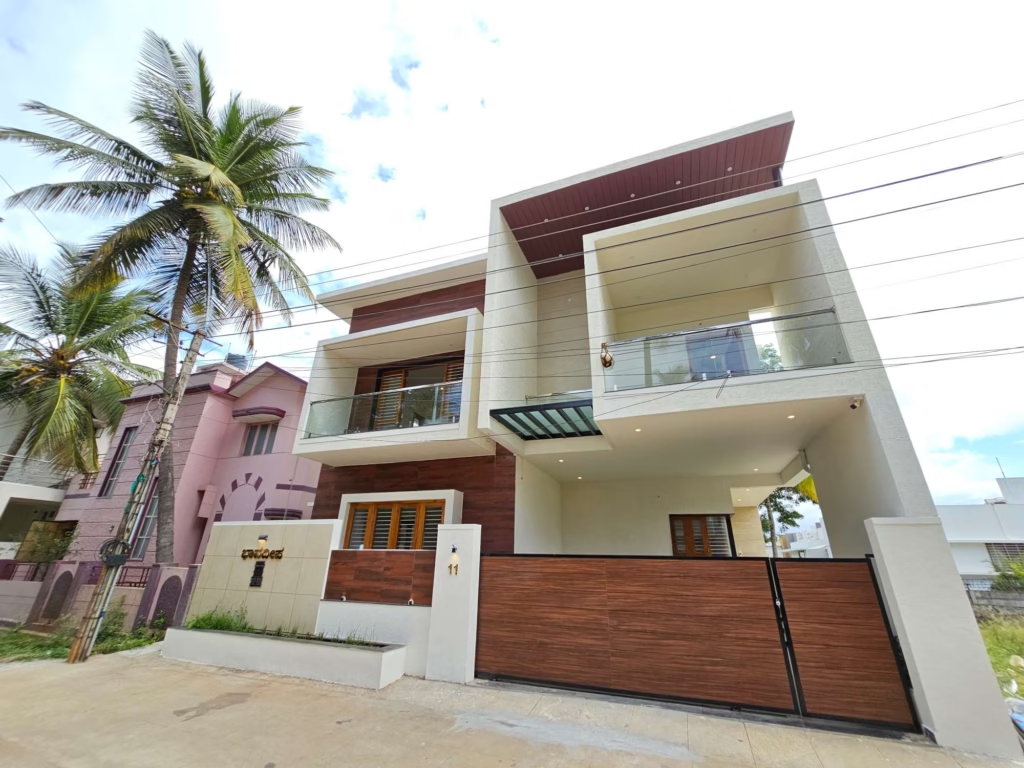
If you are building a house in Mysore or Karnataka, you have likely seen Ambuja Cement bags at your local dealer. Ambuja is one of India’s most recognised cement brands — and for good reason. Founded in 1983 and now part of the Adani Group, Ambuja Cement operates some of the most advanced cement plants in the country and holds a strong reputation for consistent quality across South India.
But Ambuja makes multiple products. Walk into any dealer and you will find Ambuja Plus, Ambuja Compocem, Ambuja Cool Walls, and others. Each is engineered for a different application. Using the wrong grade at the wrong stage of construction does not just cost money — it can compromise the structural integrity of your home for decades.
This guide explains every Ambuja Cement product available in 2026, tells you exactly which one to use at each stage of house construction, and gives you current Mysore market prices so you can plan your budget accurately.
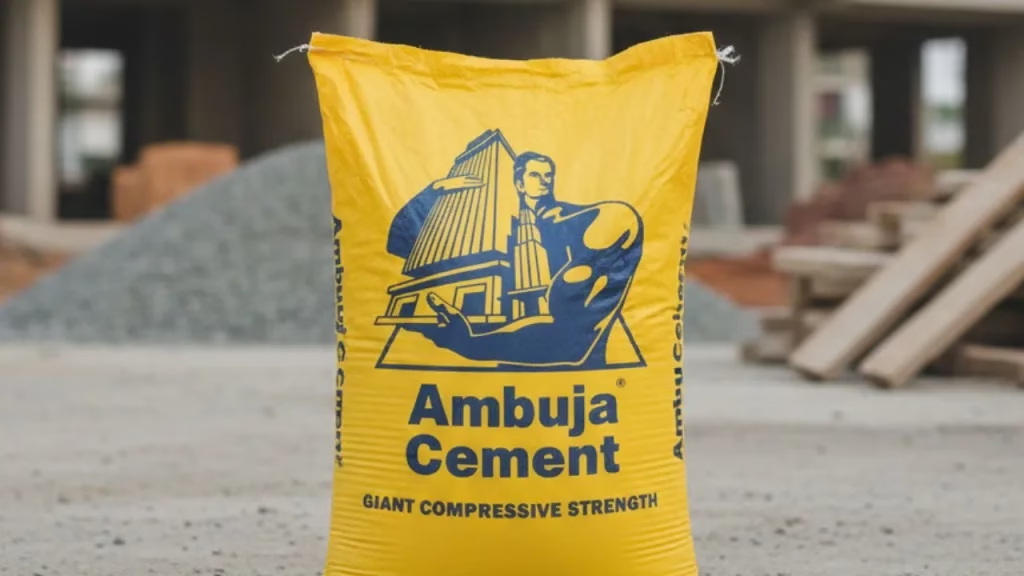
Ambuja Cement: Brand Overview
Ambuja Cement Limited was founded in 1983 in Gujarat and is now one of India’s top five cement producers by capacity. The company was acquired by the Adani Group in 2022 and has since expanded its production capacity significantly.
Key facts for Mysore builders:
- All Ambuja Cement grades carry BIS (Bureau of Indian Standards) certification
- Ambuja has a strong dealer presence across Karnataka, including Mysore, Mandya, and Hassan
- Ambuja is known particularly for its superior workability — contractors often note that Ambuja cement is easier to mix and apply than some competitors
- The brand introduced several innovative products including Cool Walls and Compocem that address specific construction challenges in South India’s climate
Ambuja Cement Product Range — What’s Available in 2026
1. Ambuja Plus (PPC — Portland Pozzolana Cement)
Grade: PPC (IS 1489) Fly ash content: ~25–30% BIS certification: Yes
Ambuja Plus is Ambuja’s flagship blended cement and the most widely available Ambuja product at dealers in Mysore. It is a Portland Pozzolana Cement — meaning it contains fly ash as a supplementary cementitious material alongside clinker.
The fly ash in PPC reacts with calcium hydroxide released during hydration to fill microscopic pores in the concrete matrix. This reaction takes time, but the end result is denser, more durable concrete that resists water penetration and sulphate attack better than pure OPC.
Strengths of Ambuja Plus PPC:
- Excellent workability — easy to mix, lay, and finish
- Lower heat of hydration — reduces thermal cracking in large pours
- High long-term durability and water resistance
- Good adhesion for plastering and masonry work
- Slightly lower cost than OPC 53
Best used for: Foundation, roof slab, brick/block masonry, plastering, flooring screed
2. Ambuja Compocem (Composite Cement)
Grade: Composite Cement (IS 16415) Composition: Clinker + fly ash + limestone powder BIS certification: Yes
Ambuja Compocem is a composite cement — a relatively newer category in India that combines clinker with two supplementary materials (fly ash and limestone fines). This three-component system offers a balance between the high early strength of OPC and the long-term durability of PPC.
Strengths of Ambuja Compocem:
- Better early strength than standard PPC while maintaining good durability
- Improved workability compared to OPC 53
- Lower carbon footprint than OPC
- Suitable for a wider range of applications than single-blend cements
Best used for: General construction where both early strength and long-term durability matter — ground floors, staircase stringers, compound walls
Note: Compocem is not as widely available at all Mysore dealers as Ambuja Plus. Confirm availability with your dealer before specifying it.
3. Ambuja OPC 53 (Ordinary Portland Cement — Grade 53)
Grade: OPC 53 (IS 269) Clinker content: ~95% 28-day compressive strength: ≥53 N/mm²
This is Ambuja’s high-strength structural grade. OPC 53 achieves design strength faster than PPC because it is almost entirely clinker with minimal supplementary material.
Strengths of Ambuja OPC 53:
- Fastest early strength gain among all Ambuja grades
- 28-day compressive strength ≥53 N/mm² — highest of all grades
- Reaches approximately 70% of 28-day strength within 7 days
- Ideal for structural RCC where formwork stripping timeline matters
Best used for: Columns, beams, staircases, compound walls — any structural RCC element
Important: OPC 53 generates more heat during hydration than PPC or Compocem. In large pours — particularly roof slabs — this excess heat causes micro-cracking. Never use OPC 53 for slabs unless your structural engineer specifically prescribes it.
4. Ambuja Cool Walls (Masonry Cement)
Type: Specialised masonry cement with thermal properties Application: Wall construction and plastering
Ambuja Cool Walls is a specialised product designed for wall masonry and external plastering in hot climates. It contains thermal-reflective additives that reduce heat transmission through walls — making interiors cooler in summer without requiring additional insulation.
For Mysore’s climate, where summer temperatures regularly cross 35°C, Cool Walls can reduce indoor temperature by 2–4°C compared to standard masonry, which has real implications for long-term electricity bills.
Best used for: External wall masonry and external plastering on residential and commercial buildings
Note: Cool Walls is a premium-priced specialty product. It is not a structural cement and cannot substitute for OPC 53 or PPC in RCC elements.
5. Ambuja White Cement and Wall Care Putty
Ambuja also produces Ambuja White Cement for decorative applications and Ambuja Wall Care Putty for interior finishing.
- White Cement: Used for tile grouting, decorative mouldings, and ornamental plasterwork. Not structural.
- Wall Care Putty: Applied over cured plaster to create a smooth, paint-ready surface. Not structural.
These are finishing products. Do not confuse them with structural cement grades when placing material orders.
Stage-by-Stage Guide: Which Ambuja Cement to Use and When
Stage 1: Foundation (Footings and Plinth Beam)
Use: Ambuja Plus PPC
Your foundation is in direct contact with soil and groundwater. Mysore’s soil — particularly in areas like Gokulam, Vijayanagar, and Hebbal — can contain mild sulphates and chlorides that attack pure OPC concrete over time. PPC’s dense microstructure, formed through the pozzolanic reaction of fly ash, provides superior resistance to this chemical attack.
PPC also generates less heat during hydration than OPC 53, which is important for large foundation pours where temperature build-up can cause early-age cracking.
Mix specification: M20 grade concrete (1:1.5:3) for standard residential footings. Water-cement ratio: 0.45–0.50. Use 20mm downgraded aggregate and clean M-sand or river sand. Cure for a minimum of 14 days.
Stage 2: Columns and Beams (RCC Frame)
Use: Ambuja OPC 53
Columns and beams carry the entire structural load of your building — all floors, the roof, water tanks, and live loads from occupants and furniture. This is where early strength gain matters most.
Ambuja OPC 53 reaches approximately 37 N/mm² at 7 days — enough to safely strip column shuttering and proceed with the next floor pour. PPC at 7 days reaches only about 22–25 N/mm², which means longer waiting periods between floors and extended project timelines.
Mix specification: M25 grade concrete (1:1:2) for columns and beams in G+1 and G+2 residential construction. Use a vibrator during pour. Cure with wet gunny sacks or continuous water ponding for a minimum of 14 days. Do not strip column shuttering before 7 days.
Stage 3: Roof Slab (RCC Slab)
Use: Ambuja Plus PPC
The roof slab is the largest continuous concrete pour in most residential projects — typically covering the full floor area in one session. Large flat pours are particularly vulnerable to heat-induced thermal cracking. PPC’s lower heat of hydration makes it the correct choice here.
A common contractor mistake is using OPC 53 for slabs to “make it stronger.” This is wrong. M20 PPC concrete easily meets the structural design requirement for residential slabs. The marginal strength gain from using OPC 53 is not worth the significant increase in thermal cracking risk.
Mix specification: M20 for residential slabs up to G+1. M25 for G+2 and above. Cure continuously for a minimum of 21 days — 28 days of water curing gives measurably better long-term strength. Cover the slab with wet gunny sacks or hessian cloth and keep them wet around the clock for the first week.
Stage 4: Brick and Block Masonry (Walls)
Use: Ambuja Plus PPC or Ambuja Cool Walls
Standard internal walls: Ambuja Plus PPC in a 1:6 mortar (cement:sand).
External walls where thermal comfort matters: Ambuja Cool Walls. The additional cost of Cool Walls is typically ₹8–15/sqft of wall area — a modest investment that reduces long-term cooling costs.
For AAC (autoclaved aerated concrete) block laying, use a thin-bed mortar joint of 6–8mm with the same PPC-based mix.
Stage 5: Plastering (Internal and External)
Use: Ambuja Plus PPC
PPC’s excellent workability makes it the contractor’s preferred choice for plastering. It spreads evenly, bonds well to masonry, and its controlled setting time means the plaster can be finished without rushing.
- Internal plaster: 1:6 (cement:sand), 12–15mm thick
- External plaster: 1:4 (cement:sand) for better weather resistance, 15–20mm thick
For external walls: apply Ambuja Cool Walls as the plaster coat (instead of standard PPC) for the thermal benefit.
After internal plaster cures fully (minimum 28 days), apply Ambuja Wall Care Putty as a finishing layer before painting.
Stage 6: Flooring and Tile Work
Use: Ambuja Plus PPC
Floor screeds, tile bedding, and grouting use PPC. Mix at 1:4 (cement:sand) for floor screeds. Pour at 40–50mm thickness over the structural slab. Allow to cure and settle before tile laying begins.
For tile adhesive work, use a polymer-modified adhesive — ask your tile supplier for compatibility with the tile thickness and substrate.
Ambuja Cement vs UltraTech Cement: Which Is Better?
This is the most common comparison question in Mysore’s construction market. Here is an objective assessment:
| Parameter | Ambuja Plus PPC | UltraTech PPC |
|---|---|---|
| BIS Certification | Yes (IS 1489) | Yes (IS 1489) |
| 28-day strength | ≥33 N/mm² | ≥33 N/mm² |
| Fly ash content | ~25–30% | ~25–30% |
| Workability | Excellent | Very good |
| Setting time (initial) | ~30 min | ~30 min |
| Karnataka dealer network | Good | Excellent |
| Price (Mysore, Sep 2026) | ₹395–₹415/bag | ₹400–₹420/bag |
| Specialty products | Cool Walls, Compocem | Super, Premium |
Verdict: Both brands meet identical BIS standards and perform comparably on site. Ambuja has a slight edge in workability — contractors who have used both brands often report that Ambuja plaster and mortar are easier to work with. UltraTech has a marginally wider dealer network in Mysore. Price difference is minimal (₹5–₹15/bag).
Ambuja Cement vs ACC Cement: Which Is Better?
Both ACC and Ambuja are part of the same parent group (Adani Group, which acquired both Ambuja and ACC). In practice, this means both brands often share production facilities, quality standards, and technical specifications.
| Parameter | Ambuja Plus PPC | ACC Suraksha PPC |
|---|---|---|
| Parent company | Adani Group | Adani Group |
| BIS Certification | Yes | Yes |
| 28-day strength | ≥33 N/mm² | ≥33 N/mm² |
| Karnataka availability | Good | Good |
| Price (Mysore, Sep 2026) | ₹395–₹415/bag | ₹395–₹415/bag |
Verdict: Functionally near-identical. Choose whichever your dealer stocks consistently and offers at a better bulk price.
Ambuja Cement vs JK Cement: Which Is Better?
| Parameter | Ambuja Plus PPC | JK Super Strong PPC |
|---|---|---|
| BIS Certification | Yes | Yes |
| 28-day strength | ≥33 N/mm² | ≥33 N/mm² |
| Workability | Excellent | Good |
| Karnataka availability | Good | Good |
| Price (Mysore, Sep 2026) | ₹395–₹415/bag | ₹390–₹410/bag |
Verdict: JK is typically ₹5–₹10/bag cheaper. Ambuja has a slight workability advantage. For structural concrete, both perform identically at the same mix design. For plastering, some contractors prefer Ambuja.
Ambuja Cement Price in Mysore — September 2026
| Product | Price per Bag (50 kg) | Cost per 100 bags |
|---|---|---|
| Ambuja Plus PPC | ₹395–₹415 | ₹39,500–₹41,500 |
| Ambuja OPC 53 | ₹415–₹435 | ₹41,500–₹43,500 |
| Ambuja Compocem | ₹400–₹420 | ₹40,000–₹42,000 |
| Ambuja Cool Walls | ₹420–₹445 | ₹42,000–₹44,500 |
Prices vary by dealer, order volume, and delivery distance. Always get 3 quotes. Bulk orders above 100 bags typically qualify for ₹5–₹15/bag dealer discount.
How Much Ambuja Cement Do You Need? (Mysore 2026)
| House Size | Estimated Bags (Complete Construction) |
|---|---|
| 600 sqft (20×30 site) | 300–350 bags |
| 1,200 sqft (30×40 site) | 550–650 bags |
| 2,400 sqft (40×60 site) | 1,000–1,200 bags |
| 3,600 sqft (60×60 site) | 1,500–1,800 bags |
Covers foundation to roof including masonry, plastering, and flooring. Actual consumption depends on design, concrete grade, and on-site wastage management.
5 Things to Check When Buying Ambuja Cement in Mysore
1. Check the manufacturing date Every Ambuja cement bag is printed with a manufacturing date. Cement older than 90 days loses significant strength due to moisture absorption and carbonation. Reject any bag older than 3 months regardless of how it was stored.
2. Look for the BIS mark All genuine Ambuja cement bags carry the Bureau of Indian Standards (BIS) certification mark. Counterfeit cement without this mark is present in some markets. Never buy cement without the BIS logo.
3. Buy from authorised Ambuja dealers Ask your dealer to show their Ambuja authorised dealership certificate. Purchase from established dealers in Mysore — Bannimantap, Hebbal Industrial Area, and Vijayanagar have reputable building material dealers with verified supply chains.
4. Do not mix grades on a single structural element If you run short of OPC 53 during a column pour and switch to PPC, you create a weak bond plane in the structural element. Order 10–15% more cement than your estimate requires and keep buffer stock on site at all times.
5. Store correctly Stack Ambuja cement bags on a raised wooden platform (never directly on the floor). Cover with polythene sheeting to prevent moisture ingress. Do not stack more than 10 bags high. Keep cement away from water sources, fertiliser, and lime.
Frequently Asked Questions
Yes. Ambuja Plus PPC is a high-quality, BIS-certified cement well-suited for most stages of residential construction — foundation, slab, masonry, and plastering. For structural RCC columns and beams, use Ambuja OPC 53 for faster strength gain.
Both meet identical BIS standards. Ambuja has a slight workability advantage noted by many contractors. UltraTech has a wider dealer network in Mysore. Price difference is ₹5–₹15/bag. If your contractor has consistent supply from a trusted dealer for either brand, stick with that for consistency.
Not recommended. Columns and beams require high early strength so formwork can be stripped on schedule. Use Ambuja OPC 53 for all structural RCC elements. PPC’s slower strength gain means longer shuttering periods and delayed floor-to-floor construction cycles.
What is Ambuja Cool Walls and should I use it? Ambuja Cool Walls is a specialty masonry cement with thermal-reflective properties. It reduces heat transmission through walls, keeping interiors cooler. It is worth using for external walls and external plaster in Mysore’s hot summers. It is not a structural cement.
What is the price of Ambuja cement in Mysore in 2026? Ambuja Plus PPC is priced at approximately ₹395–₹415 per 50 kg bag in Mysore as of September 2026. OPC 53 is ₹415–₹435/bag. Prices vary by dealer and order size.
Summary: Ambuja Cement Stage-by-Stage Quick Reference
| Construction Stage | Ambuja Cement to Use |
|---|---|
| Foundation (footings, plinth beam) | Ambuja Plus PPC |
| Columns and beams | Ambuja OPC 53 |
| Roof slab | Ambuja Plus PPC |
| Brick/block masonry (internal walls) | Ambuja Plus PPC |
| External wall masonry | Ambuja Cool Walls (or Ambuja Plus PPC) |
| Plastering (internal) | Ambuja Plus PPC |
| Plastering (external) | Ambuja Cool Walls (or Ambuja Plus PPC) |
| Flooring screed | Ambuja Plus PPC |
| Finishing coat | Ambuja Wall Care Putty |
Building a House in Mysore? Talk to Zenith Constructions
At Zenith Constructions, we source cement exclusively from BIS-certified authorised dealers — Ambuja, UltraTech, ACC, or JK, depending on availability, project stage, and client preference. Every material decision is documented and shared with the client.
We manage end-to-end home construction in Mysore — from soil testing and MUDA approval to final handover. Our construction packages start from ₹1,999/sqft.
Contact us for a free site visit and itemised construction estimate for your plot in Mysore.