
If you’ve ever sat with a contractor going over your house construction plan, you’ve probably heard the term PCC thrown around — usually in the same breath as foundation work or flooring.
Most homeowners nod along and move on. But here’s why you shouldn’t:
PCC is the very first layer of concrete that goes into your home. Get it wrong — or skip it — and everything built above it is compromised. Get it right, and it silently protects your foundation, your flooring, and your entire structure for decades.
In this complete guide, Zenith Construction explains exactly what PCC is, why it matters, where it is used, what the correct mix ratio is, and how to make sure your builder is doing it properly.
What Is PCC in Construction?
PCC stands for Plain Cement Concrete.
It is a construction material made by mixing cement, sand (fine aggregate), and coarse aggregate (crushed stone or gravel) with water, without any steel reinforcement. This is what distinguishes it from RCC (Reinforced Cement Concrete), which contains steel bars embedded within the concrete.
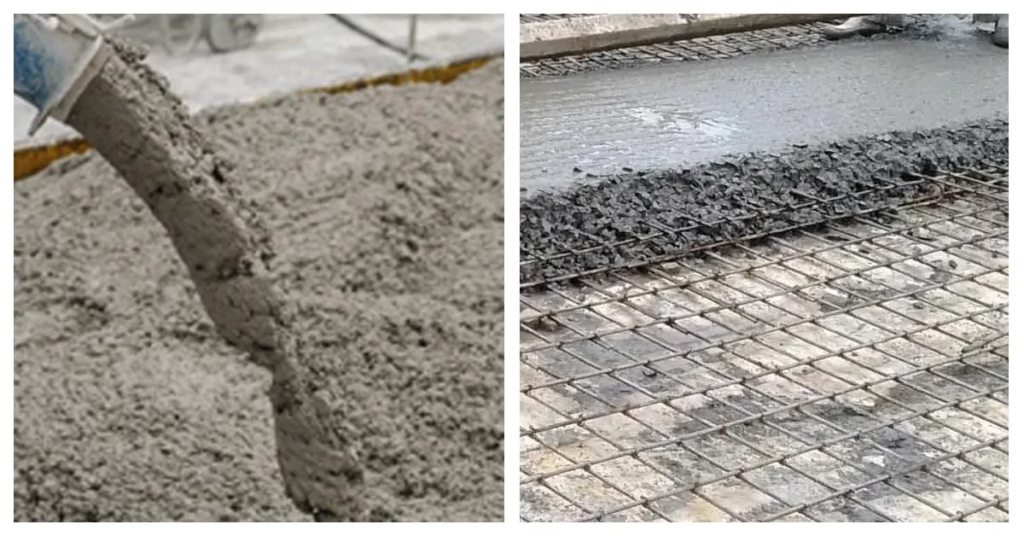
PCC is not a structural material in the load-bearing sense. It is not designed to take tensile stress or bending forces. Its job is different — and equally important:
- To create a clean, level, and hard-working surface before structural concrete or flooring is laid
- To prevent direct contact between structural concrete and soil
- To block moisture and soil contamination from affecting the structure above
Think of PCC as the base coat before the actual painting. You wouldn’t paint directly on a rough, uneven wall. Similarly, a professional builder never pours structural RCC directly onto raw soil.
PCC Full Form and Definition
| Term | Full Form | Definition |
|---|---|---|
| PCC | Plain Cement Concrete | Concrete without steel reinforcement — used as a levelling, protective base layer |
| RCC | Reinforced Cement Concrete | Concrete with steel bars — used for load-bearing structural elements |
| DPC | Damp Proof Course | A waterproof layer, often built on top of PCC, to prevent rising moisture |
| BPC | Brick Paving Course | Sometimes used interchangeably with PCC in flooring contexts — technically different |
Where Is PCC Used in House Construction?
PCC appears at multiple stages of residential construction. Here are the key locations where it is used:
1. Foundation Bed (Footing PCC)
This is the most critical use of PCC. Before the footing (the wide base of a column) is poured, a layer of PCC is laid at the bottom of the excavated pit. This layer:
- Creates a clean, level surface for accurate footing layout
- Prevents soil particles from contaminating the footing concrete
- Stops moisture from the ground migrating into the structural concrete
- Allows accurate placement of steel reinforcement bars
Standard thickness: 75mm to 150mm (3 to 6 inches) depending on soil type and structural load.
2. Under Column Footings
Every column in your home sits on a footing, and every footing sits on a PCC bed. Without this layer, the footing concrete mixes with loose soil at the base, reducing the effective concrete strength and creating uneven load transfer to the ground.
3. Flooring Base (Floor PCC)
Before any flooring — vitrified tiles, marble, granite, or even cement finishing — is laid, a layer of PCC is applied as a levelling bed across the entire floor area. This:
- Ensures a perfectly level surface for tile adhesive or bedding mortar
- Provides a hard, stable base that prevents tiles from cracking or hollow sounds
- Acts as a waterproofing aid in ground floor areas
Standard thickness: 50mm to 100mm for floor PCC.
4. Plinth Beam Level
At plinth beam level (the beam that connects all columns just above ground), PCC is used to fill and level the area before the beam is cast and before flooring work begins.
5. Pathways, Driveways, and Compound Areas
PCC is used for outdoor non-structural surfaces — driveways, pathways, compound flooring, parking areas — where vehicular or foot traffic needs a hard surface but steel reinforcement is not required.
6. Retaining Wall Base
At the base of retaining walls, a PCC bed is laid to provide a stable, level foundation for the wall structure.
7. Septic Tank and Sump Base
The base of underground water tanks and septic tanks typically uses PCC as a foundation layer before the waterproofed RCC structure is cast.
PCC Mix Ratio — What Is the Correct Proportion?
The mix ratio of PCC determines its strength and workability. In India, PCC mix ratios are specified using the cement: sand: aggregate format.
Most Common PCC Mix Ratios
| Mix Ratio | Grade Equivalent | Compressive Strength | Common Use |
|---|---|---|---|
| 1 : 5 : 10 | M5 | 5 MPa | Lean concrete, mass filling |
| 1 : 4 : 8 | M7.5 | 7.5 MPa | General PCC bed under footings |
| 1 : 3 : 6 | M10 | 10 MPa | Standard foundation PCC, floor PCC |
| 1 : 2 : 4 | M15 | 15 MPa | Higher load areas, driveway PCC |
| 1 : 1.5 : 3 | M20 | 20 MPa | Structural PCC, heavy traffic areas |
What Mix Should Your House Use?
For residential construction in Mysore, the standard practice followed by Zenith Construction is:
- Under footings and columns: M10 (1:3:6) minimum — M15 (1:2:4) for larger structures
- Floor PCC (ground floor): M10 (1:3:6)
- Driveway and pathway PCC: M15 (1:2:4)
- Heavy-duty outdoor areas: M20 (1:1.5:3)
Using M5 or M7.5 under a column footing in a multi-storey house is a common cost-cutting shortcut that some contractors take. It looks identical to the naked eye — but the difference in load transfer and moisture resistance is significant.
PCC vs RCC — Key Differences Explained
This is one of the most common points of confusion for homeowners. Here is a clear comparison:
| Feature | PCC (Plain Cement Concrete) | RCC (Reinforced Cement Concrete) |
|---|---|---|
| Full form | Plain Cement Concrete | Reinforced Cement Concrete |
| Steel reinforcement | No | Yes — steel bars (rebars) |
| Tensile strength | Very low | High |
| Compressive strength | Moderate | High |
| Primary purpose | Levelling, protection, base layer | Load-bearing structural elements |
| Used in | Foundation bed, floor base, pathways | Columns, beams, slabs, footings |
| Cost | Lower | Higher |
| Can it replace RCC? | Never in structural applications | Not needed for base/levelling work |
The most important rule: PCC and RCC are not interchangeable. PCC is never used as a substitute for structural RCC. Any contractor who suggests skipping the PCC layer under footings to “save cost” is compromising the integrity of your entire foundation.
PCC vs Screed — What Is the Difference?
Another term often confused with PCC is screed or screeding.
| Feature | PCC | Screed |
|---|---|---|
| Composition | Cement + sand + coarse aggregate | Cement + fine sand only (no coarse aggregate) |
| Thickness | 50–150mm | 25–50mm |
| Primary use | Base layer, foundation bed | Final levelling before tiling |
| Structural role | Minor structural protection | Non-structural, finishing only |
| When applied | Before structural elements | After the structural slab, before the flooring |
In simple terms, PCC provides the structural base. Screed provides the smooth, level finishing layer immediately below tiles or flooring.
How Is PCC Prepared and Laid? Step-by-Step
Understanding the PCC laying process helps you supervise your construction site effectively.
Step 1: Excavation and Soil Preparation
The area where PCC will be laid — whether a footing pit or a floor area — is excavated to the required depth. Loose soil is compacted using a plate compactor or hand tamper. This is critical: soft or loose sub-base will cause PCC to crack and settle unevenly.
Step 2: Anti-termite Treatment (for floor PCC)
Before floor PCC is laid, a chemical anti-termite treatment is applied to the soil surface. This is a BIS-recommended practice for all ground floor areas in India and protects wooden elements and flooring from termite damage.
Step 3: Mixing the Concrete
PCC is mixed either manually (for small areas) or using a concrete mixer (recommended for all applications). The cement, sand, and aggregate are measured by volume using gauge boxes — never by eye or approximation. Water is added to achieve the right workability (slump).
Critical point: Excess water is the most common quality defect in PCC. Adding more water makes the mix easier to pour but dramatically reduces final strength. The water-cement ratio must be controlled strictly.
Step 4: Pouring and Spreading
The mixed concrete is poured into the prepared area and spread evenly using screeding rods or a straight edge to achieve a level surface. For footing PCC, the thickness is checked with a measuring rod at multiple points.
Step 5: Compaction
The poured PCC is compacted using tamping rods or a plate vibrator (for larger pours) to eliminate air pockets. Air voids in concrete reduce strength — a rule of thumb is that every 1% of entrapped air reduces compressive strength by approximately 5%.
Step 6: Surface Finishing
Once compacted, the surface is finished smooth using a float or trowel. For foundation PCC, a rough surface is often left intentionally to improve bond with the structural concrete above.
Step 7: Curing
This is the most critical and most neglected step. PCC must be water-cured for a minimum of 7 days after casting. Curing keeps the concrete moist, allowing the cement hydration reaction to complete fully and achieve design strength. Uncured PCC loses up to 30–40% of its potential strength.
Curing methods include:
- Ponding (flooding the surface with water)
- Wet hessian cloth covering
- Curing compounds (chemical spray-on membrane)
Thickness of PCC — What Is Standard?
| Location | Minimum PCC Thickness | Zenith Standard |
|---|---|---|
| Under column footing | 75mm | 100mm |
| Driveway/pathway | 75mm | 100mm |
| Ground floor bed | 50mm | 75mm |
| Sump/tank base | 75mm | 100mm |
| Compound area | 50mm | 75mm |
| Sump / tank base | 75mm | 100mm |
Reducing PCC thickness below minimum standards is one of the most common cost-cutting practices among low-quality contractors. It is invisible once covered — which is exactly why it happens.
At Zenith Construction, we document PCC thickness at every stage with photographs shared with our clients before the next layer is poured.
What Happens If PCC Is Skipped or Done Poorly?
Here is the real-world impact of poor or missing PCC — problems Zenith Construction has been called to remediate in homes built by others:
1. Foundation settlement and cracking Without a PCC bed, footing concrete mixes with loose soil, creating inconsistent bearing capacity. This leads to differential settlement — where one part of the foundation sinks more than another — causing diagonal cracks in walls and even structural distress.
2. Rising damp and moisture problems Without PCC under the floor, ground moisture migrates upward through capillary action. This causes floor tiles to delaminate, walls to develop dark patches and peeling paint, and wooden furniture to swell and rot.
3. Floor tile hollow sounds and cracking When floor PCC is skipped or under-thickness, tiles lose their firm base over time. Foot traffic and load cause tiles to crack, develop hollow spots, and eventually require complete re-tiling — a costly and disruptive repair.
4. Reinforcement corrosion When structural RCC is poured without a PCC bed, the lowermost steel bars can come in direct contact with soil moisture. This accelerates corrosion of the steel — a process that begins invisibly and causes severe structural damage over 10–15 years.
How to Verify PCC Quality on Your Construction Site
You don’t need to be a civil engineer to check PCC quality. Here are practical steps any homeowner can take:
1. Check the mix ratio Ask your contractor to show you the gauge boxes being used to measure cement, sand, and aggregate. Each material should be measured separately — never mixed by approximation or shovelfuls.
2. Check the water quantity The mix should be workable but not runny. A rough test: take a handful of mixed concrete. It should hold its shape when squeezed but not release free water. Excessively wet mixes are a red flag.
3. Check the thickness Before the next layer is poured, measure the PCC depth at three or four locations using a steel scale. It should match the specified thickness.
4. Check the curing Visit the site 24 hours after PCC is poured. The surface should be wet — either covered with hessian cloth or flooded with water. Dry, dusty PCC one day after pouring is a quality failure.
5. Ask for photographs Insist your contractor photograph the PCC layer before it is covered by footing concrete or flooring. These photos are your record of what was done.
PCC in Mysore Construction — Local Considerations
Mysore’s soil profile varies significantly across localities. Here is what Zenith Construction’s site engineers account for when specifying PCC:
Black cotton soil zones (parts of Mysore outskirts): Black cotton soil expands when wet and contracts when dry — a phenomenon called swelling-shrinkage. In these areas, PCC thickness is increased and a sand blinding layer is added below the PCC to reduce the soil movement transmitted to the structure.
Rocky sub-strata (parts of Vijayanagar, Hebbal): Where rock is encountered at shallow depths, PCC thickness can sometimes be reduced — but the rock surface must be cleaned of loose material and debris before PCC is poured.
High water table areas (low-lying parts of Mysore): In areas with shallow groundwater, PCC under floor and foundation is combined with a waterproof membrane or DPC (Damp Proof Course) to prevent moisture ingress.
At Zenith Construction, we conduct a site visit and soil assessment before finalising PCC specifications — because a one-size-fits-all approach to PCC does not exist in a geologically varied city like Mysore.
Common Questions About PCC — Answered
Q: Can I use PCC as the final floor surface? Yes, for utility areas like parking, storage rooms, and terraces, a PCC floor with a smooth finish is a practical, low-cost option. It is not suitable as a final finish in living areas.
Q: Is PCC waterproof? Standard PCC is not waterproof. However, waterproofing admixtures can be added to PCC mix in areas exposed to water — such as terrace floors and sump bases — to improve water resistance.
Q: How long should I wait before pouring RCC on top of PCC? A minimum of 24 hours after PCC is cast. Most engineers recommend waiting until the PCC has achieved initial set and hardness — typically 24–48 hours — before placing formwork and steel on top.
Q: Does PCC need steel reinforcement? No. By definition, PCC is unreinforced. If the design calls for a reinforced base slab (as in some heavy structures), that becomes RCC — not PCC.
Q: What is lean concrete? Is it the same as PCC? Lean concrete is a very low cement content concrete (usually M5 or M7.5) used purely as a filler or blinding layer. It is a type of PCC but at the lower end of the strength spectrum. The term is often used interchangeably with PCC in the context of foundation blinding.
Zenith Construction’s PCC Standard
After 11+ years of residential and commercial construction across Mysore and Bangalore, here is the non-negotiable PCC standard at every Zenith project:
- Minimum M10 grade PCC under all footings and floor areas
- Thickness never below 75mm under footings, 50mm under floors
- Mix by gauge box measurement — never by approximation
- Mandatory 7-day water curing on all PCC pours
- Anti-termite treatment applied before ground floor PCC
- Photographic documentation at every PCC stage, shared with clients
- Site engineer present during all PCC pours
This is not optional on a Zenith site. It is standard practice — because PCC is the invisible foundation of everything your family will live on for generations.
Planning to Build in Mysore? Start With the Right Foundation.
Every great home starts with the right base — and that starts with proper PCC. At Zenith Construction, we don’t cut corners at the foundation stage or anywhere else. Our 11+ years of experience and hundreds of completed homes across Mysore speak for themselves.
We offer a FREE consultation — our team will visit your plot, assess the soil conditions, and give you a detailed, honest construction plan starting from just ₹1999/sqft including GST.
No hidden charges. No vague quotes. Just transparent, quality construction.
📞 Call us: 961-118-4850 / 991-619-3939 📧 Email: info@zenithconstruction.in 📍 Visit: #378, Prakash Complex, 2nd Floor, Akkamahadevi Rd, C-Block, JP Nagar, Mysuru – 570008
Book Your FREE Appointment → zenithconstruction.in
Zenith Construction — Best Construction Company in Mysore & Bangalore. Building strong from the ground up.
Tags: what is PCC in construction, PCC full form in construction, plain cement concrete, PCC vs RCC, PCC mix ratio, PCC in foundation, construction company Mysore, best builders Mysore, Zenith Construction Mysore