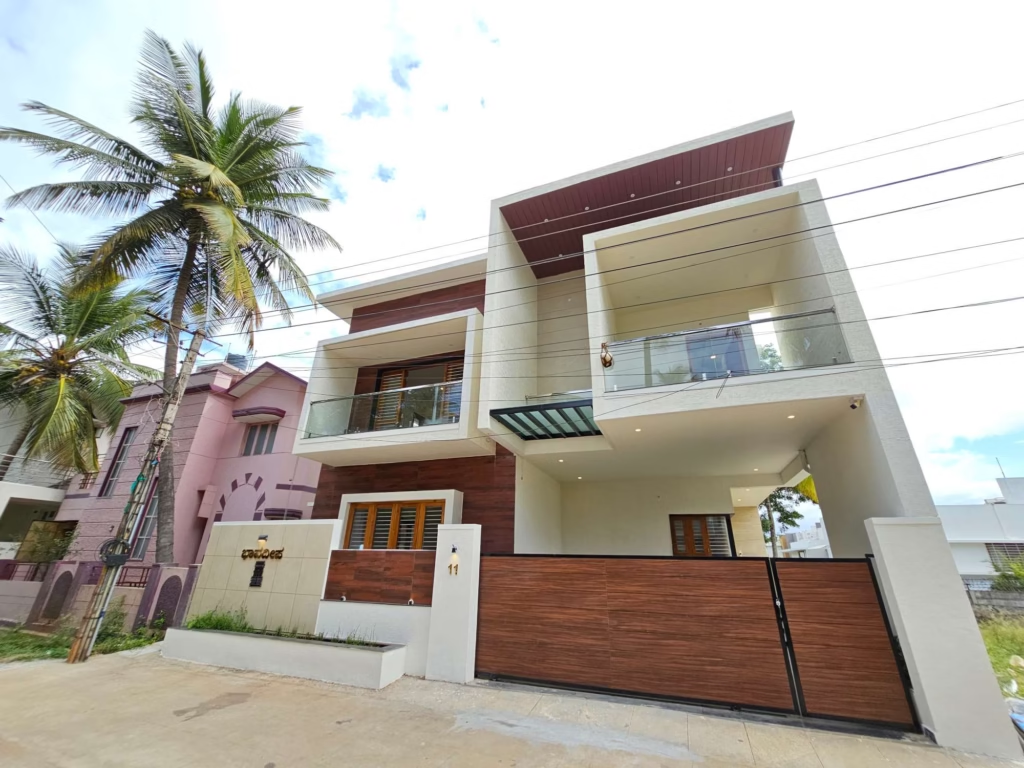
Building a home in Mysore is a dream for thousands of families. However, construction costs can quickly spiral out of control if you are not careful. Material prices rise. Scope changes add up. Contractors charge more than quoted. And before you know it, your ₹25 lakh budget has become a ₹35 lakh project — with no end in sight.
The good news is that reducing home construction cost in Mysore does not mean building a poor quality home. It means building a smart home. It means making the right decisions at the right time — before the first brick is laid, not after.
In this blog, we share 15 proven, practical ways to reduce your home construction cost in Mysore without cutting corners on quality, safety, or durability. These are not shortcuts. These are smart choices that experienced builders use every single day.
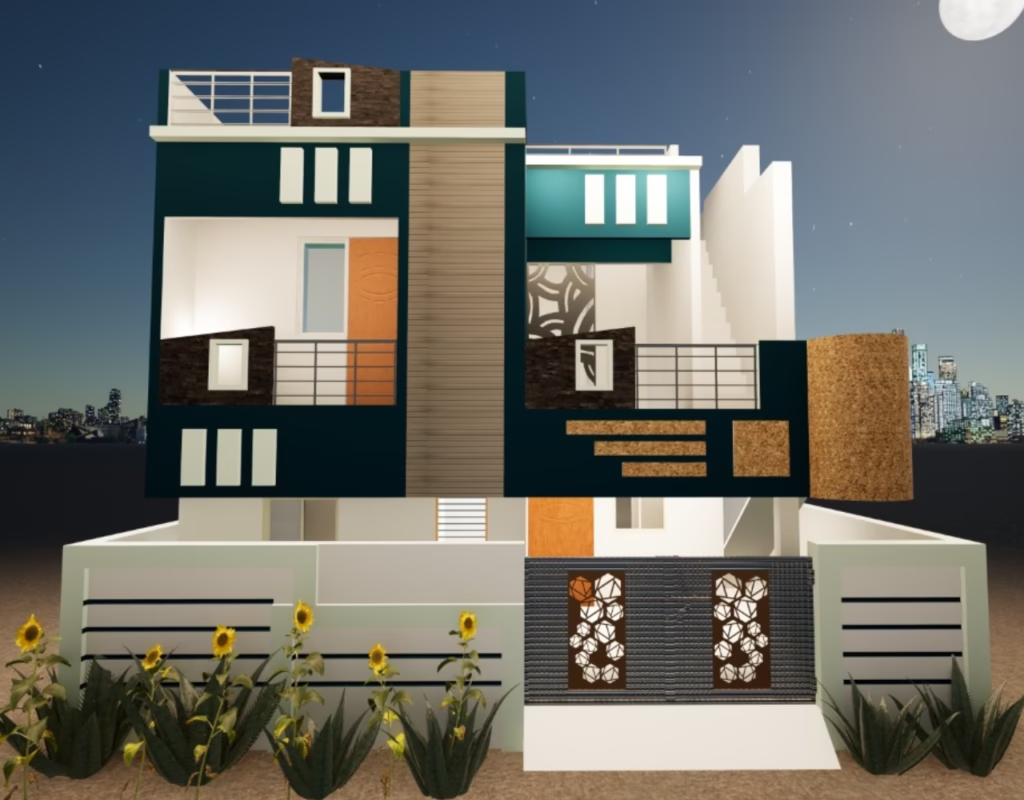
Why Do Construction Costs Spiral Out of Control?
Before looking at solutions, it helps to understand why costs go wrong in the first place. In our 11 years of building homes across Mysore, we have seen the same patterns repeat over and over:
Design changes during construction. This is the single biggest cost killer. Every change after structural work begins costs 3 to 5 times more than it would have during the planning stage. A door shifted by 2 feet during construction can cost ₹15,000 to ₹30,000 in rework — the same change during design costs nothing.
No written contract or material specifications. Without a clear contract, contractors use cheaper materials and charge you for better ones. Without written specs, every item becomes a negotiation — and you almost always lose.
Choosing the wrong contractor. The cheapest quote is rarely the cheapest project. Low-ball contractors make up the difference through material substitution, hidden charges, and abandoned work when payments slow down.
No contingency budget. Homeowners who plan their budget to the last rupee inevitably face a crisis the moment something unexpected happens — and something unexpected always happens.
Buying materials without research. Tiles, sanitary ware, electrical fittings, and paints have enormous price variation for the same quality. Buying without comparing dealers can easily cost you 15 to 20% more than necessary.
Understanding these root causes is the first step. Now let us look at the solutions.
1. Finalize Your Design Completely Before Construction Starts
This is the single most powerful way to reduce construction cost — and it costs nothing.
Every experienced builder will tell you the same thing: the most expensive words in construction are “can we change this?” Changes during construction are not just inconvenient — they are enormously costly. Walls have to be broken. Plumbing has to be rerouted. Electrical conduits have to be redone. Labour time is wasted. Materials are discarded.
Therefore, spend as much time as needed on your design before work begins. Walk through every room mentally. Think about where every switch, plug point, and light fitting goes. Decide your kitchen layout, bathroom positions, and door swing directions. Confirm window sizes and positions. Think about future needs — will you need a home office? An extra bedroom? A prayer room?
The more thoroughly you plan before construction, the less you spend during it.
Potential savings: ₹1,50,000 – ₹4,00,000 on a typical Mysore home
2. Choose a Simple, Rectangular Layout
Architecture is beautiful — but complexity is expensive. Every curve, cantilever, irregular angle, and non-standard shape in your home’s design adds cost. Curved walls need more labour and material. Cantilevers need additional structural support. Complex rooflines need more waterproofing and more skilled labour.
A simple, rectangular floor plan is not boring — it is smart. Some of the most beautiful, functional homes in Mysore are built on perfectly rectangular layouts. The money saved on structural complexity can instead be spent on better finishes, better tiles, or better kitchen fittings — things you see and use every day.
Practical tip: Ask your architect to design a layout where all columns align on a simple grid. This reduces beam spans, reduces steel consumption, and speeds up construction significantly.
Potential savings: ₹1,00,000 – ₹3,00,000 on a typical Mysore home
3. Choose AAC Blocks Over Red Bricks
This is one of the smartest material switches you can make — and one that most homeowners overlook.
AAC (Autoclaved Aerated Concrete) blocks cost slightly more per unit than traditional red clay bricks. However, they offer significant advantages that reduce overall construction cost:
- Lighter weight — reduces structural load on columns and beams, which means less steel and concrete needed in the structure
- Better insulation — keeps interiors cooler in Mysore’s warm climate, reducing electricity bills for years after construction
- Faster construction — AAC blocks are larger and easier to lay, reducing labour time and cost
- Less plastering material — smoother surface requires less plaster to finish
- Less breakage — fewer damaged blocks during construction compared to red bricks
When you factor in all these savings, AAC blocks often work out cheaper than red bricks on the total project cost — even though the per-unit price is higher.
Potential savings: ₹50,000 – ₹1,50,000 on a typical Mysore home
4. Buy Key Materials Directly from Dealers
One of the most straightforward ways to save money in construction is to buy major materials directly from dealers rather than through your contractor.
When your contractor buys materials on your behalf, they typically add a margin of 10 to 15%. On big-ticket items like tiles, sanitary ware, electrical fittings, and paints, this margin adds up quickly. For example, on ₹3 lakhs worth of tiles and sanitary fittings, a 12% contractor margin costs you ₹36,000 extra.
Instead, ask your contractor for the exact specifications — brand, grade, size, and quantity — and buy directly from the dealer. Most dealers in Mysore offer competitive prices and free delivery for bulk orders.
Items to buy directly:
- Floor and wall tiles
- Sanitary fittings and bathroom accessories
- Electrical switches, wires, and distribution boards
- Paints and primers
- Doors and windows (frame and shutter)
Potential savings: ₹50,000 – ₹1,50,000 on a typical Mysore home
5. Do Not Overbuild Your Foundation
Foundation over-engineering is surprisingly common — and surprisingly expensive. Some contractors recommend deeper or heavier foundations than the soil actually requires, either out of excessive caution or to increase their billing.
The right foundation is determined by your soil test (bore test) results. A proper structural engineer will design the minimum foundation that safely supports your home for its full design life. Nothing more, nothing less.
Therefore, always get a soil test done before foundation design. The test costs ₹5,000 to ₹10,000 on a small plot. However, it can save you ₹50,000 to ₹2,00,000 by ensuring you build the right foundation — not an unnecessarily heavy one.
That said, never go the other way and underbuilding your foundation to save money. The foundation is the one place where you must never compromise. The point here is to build the right foundation — not the most expensive one or the cheapest one.
Potential savings: ₹50,000 – ₹2,00,000 on a typical Mysore home
6. Build in Phases if Your Budget is Tight
This is a very common and perfectly sensible approach in Mysore — and one that many families successfully use to manage construction costs without taking large loans.
The idea is simple. Design your full home from the start — G+1 or G+2 as planned. However, only construct what you can comfortably afford right now. Complete the structure and ground floor fully and move in. Then build the first floor when savings allow — whether that is one year or three years later.
The critical rule is that your structure must be designed for the full height from day one. Columns, beams, and slabs must be designed and built to support all planned floors — even if only the ground floor is initially constructed. This is non-negotiable. Adding floors to a structure not designed for them is dangerous and extremely expensive to fix.
When done correctly, phase-wise construction lets you spread the financial burden over time without taking on more debt than you are comfortable with.
Potential savings: Reduces upfront cost by 40 to 60% for phase 1
7. Standardize Your Door and Window Sizes
Custom sizes for doors and windows cost significantly more than standard sizes. A non-standard door frame requires custom fabrication, which takes more time and costs more money. Similarly, non-standard window sizes mean custom cutting of glass and frames — adding both cost and time.
Therefore, work with your architect to standardize all door and window sizes across your home. Standard door sizes in India are 7 feet high by 2.5 or 3 feet wide. Standard window sizes are 3×4, 4×4, or 4×5 feet. Sticking to these sizes means readily available frames, shutters, and glass — at standard market prices.
Furthermore, using the same window size throughout the house lets you order in bulk, which often gets you a better price from the supplier.
Potential savings: ₹20,000 – ₹80,000 on a typical Mysore home
8. Choose the Right Flooring for Each Area
Flooring is one of the biggest cost variables in home construction — and one of the easiest places to make smart savings without any visible compromise in quality.
The key insight is that not every area of your home needs the same quality of flooring. Here is a practical room-by-room approach:
| Area | Smart Choice | Why |
|---|---|---|
| Living and dining room | Good quality vitrified tiles (₹60–₹100/sqft) | High visibility — worth spending a little more |
| Bedrooms | Standard vitrified tiles (₹50–₹80/sqft) | Covered partly by furniture — don’t overspend |
| Kitchen | Anti-skid ceramic tiles (₹40–₹70/sqft) | Practical, easy to clean, durable |
| Bathrooms | Anti-skid ceramic tiles (₹40–₹60/sqft) | Standard is perfectly fine here |
| Utility and store | Basic tiles or cement finish (₹20–₹40/sqft) | No one sees this area |
| Terrace | Terrace tiles or IPS finish (₹25–₹50/sqft) | Focus on waterproofing not aesthetics |
By mixing flooring grades this way, you get a home that looks great where it counts — and saves money where it does not.
Potential savings: ₹50,000 – ₹2,00,000 on a typical Mysore home
9. Plan All Electrical and Plumbing Points Before Construction
This sounds obvious — but it is one of the most commonly ignored money-saving tips in home construction.
Every electrical point and plumbing connection that is added after plastering is done costs 3 to 4 times more than if it had been planned from the start. Breaking plaster, rerouting conduits, patching walls, and repainting costs time and money that could easily have been avoided.
Therefore, before your walls are plastered, walk through every room with your electrical contractor and mark every single point — lights, fans, switches, plug points, AC points, geyser points, TV points, internet points, and CCTV provisions. Do the same for plumbing — mark every tap point, drainage point, and geyser connection.
It takes a few hours of your time before plastering. However, it can save you ₹50,000 to ₹1,50,000 in rework costs later.
Potential savings: ₹50,000 – ₹1,50,000 on a typical Mysore home
10. Avoid a Basement Unless Absolutely Necessary
Basements are expensive — more expensive than most homeowners realize. Excavation costs, waterproofing costs, structural reinforcement costs, and the time added to the construction schedule all make basements one of the least cost-effective additions to a home in Mysore.
In most Mysore neighborhoods, a well-designed ground floor with a good sump and utility space serves all practical purposes that a basement would serve. Moreover, Mysore’s soil conditions in many areas — particularly near lakes and low-lying zones — make basements particularly challenging and expensive to waterproof properly.
Unless you have a specific, compelling reason for a basement — such as a parking requirement that cannot be met otherwise — avoid it. The same money spent on ground floor and upper floor construction gives you far more usable, comfortable space.
Potential savings: ₹5,00,000 – ₹15,00,000 on a typical Mysore home
11. Use OPC Cement for Structure and PPC for Finishing
Cement is not one-size-fits-all — and using the right cement in the right place saves money without compromising quality.
OPC 53 grade cement is the right choice for structural work — foundations, columns, beams, and slabs. It sets faster and achieves higher early strength, which is exactly what structural elements need.
PPC (Portland Pozzolana Cement) is the right choice for brickwork, plastering, and finishing work. It is slightly cheaper than OPC, workable for longer, and actually performs better than OPC in non-structural applications because it reduces cracking and improves finish quality.
Many homeowners and even some contractors use OPC throughout the entire construction — which is unnecessary and more expensive than needed. Switching to PPC for all non-structural work reduces cement costs without any compromise in quality.
Practical tip: Always use established brands — Ultratech, ACC, Dalmia, or Ramco. Cheap or unknown brand cement is never worth the risk to your home’s structural integrity.
Potential savings: ₹20,000 – ₹60,000 on a typical Mysore home
12. Get at Least Three Quotes — and Read Them Carefully
Never accept the first quote you receive — and never choose purely on price. Instead, get at least three detailed quotes from reputable contractors in Mysore and compare them carefully.
When comparing quotes, look beyond the total price. Check what is specifically included and excluded. Check the material brands and grades specified. Check the payment schedule. Check whether the quote includes labour, supervision, and project management or just materials.
A quote that appears ₹2 lakhs cheaper might be excluding waterproofing, compound wall, painting, or electrical work — items that will inevitably add to the final cost. Therefore, always compare like for like.
Furthermore, ask each contractor for references from recent projects and speak to those homeowners directly. A contractor with a slightly higher quote but a strong track record of on-time, on-budget delivery is almost always the better choice.
Potential savings: ₹1,00,000 – ₹3,00,000 on a typical Mysore home
13. Time Your Construction to Avoid Peak Season
Construction costs in Mysore are not the same throughout the year. Labour rates and material availability both fluctuate with seasons — and timing your project smartly can save you meaningful money.
Avoid starting construction just before or during festival seasons — Dasara, Diwali, and the summer months of April to June see higher labour demand and sometimes higher rates as workers travel home for festivals or take up other seasonal work.
The best time to start construction in Mysore is typically January to March. Labour is readily available, material supply is stable, and the pre-monsoon months give you a good window to complete structural work before the rains arrive. Furthermore, completing your roof slab before the monsoon saves the cost and inconvenience of protecting an open structure during heavy rainfall.
Avoid monsoon construction if possible — June to September construction slows down due to rain, increases waterproofing requirements during construction, and raises the risk of quality issues in concrete work.
Potential savings: ₹30,000 – ₹1,00,000 on a typical Mysore home
14. Do Not Over-Specify Every Room
Premium is not always better — especially when it adds cost without adding visible value. One of the most common ways homeowners overspend is by specifying premium materials in every single area of the home, including areas that very few people ever see or use.
Here is a practical framework:
Spend well on:
- Living room flooring and ceiling
- Main door
- Master bedroom
- Kitchen platform and fittings
- External elevation and paint
Save on:
- Utility room and store room finishes
- Terrace flooring
- Servant bathroom fittings
- Internal doors for utility areas
- Garage or parking floor finish
This approach — spending where it counts and saving where it does not — gives you a home that feels premium without costing like one.
Potential savings: ₹1,00,000 – ₹3,00,000 on a typical Mysore home
15. Work With a Transparent, Fixed-Price Builder
This is perhaps the most underrated money-saving tip of all — and the one that makes the biggest difference to your final bill.
Working with a builder who offers a fixed-price package with complete material specifications eliminates the two biggest cost risks in home construction: hidden charges and material substitution.
Hidden charges are costs that were never mentioned in the original quote but appear on bills during construction — mobilization charges, supervision fees, tool charges, and miscellaneous items that add up to lakhs. A transparent builder includes everything in the contract upfront.
Material substitution is when a contractor quotes for a certain brand or grade of material but uses a cheaper one during construction — pocketing the difference. A builder with clear, written material specifications and site supervision cannot do this.
At Zenith Construction, we offer fixed-price packages starting at ₹1,999 per sqft including GST — with a complete material specification sheet, written contract, and dedicated site supervision. What we quote is what you pay. No surprises.
Potential savings: ₹2,00,000 – ₹6,00,000 on a typical Mysore home
Total Potential Savings Summary
| Tip | Potential Saving |
|---|---|
| Finalize design before construction | ₹1,50,000 – ₹4,00,000 |
| Choose simple rectangular layout | ₹1,00,000 – ₹3,00,000 |
| Use AAC blocks over red bricks | ₹50,000 – ₹1,50,000 |
| Buy materials directly from dealers | ₹50,000 – ₹1,50,000 |
| Right-size your foundation | ₹50,000 – ₹2,00,000 |
| Build in phases | Reduces upfront cost by 40–60% |
| Standardize door and window sizes | ₹20,000 – ₹80,000 |
| Choose right flooring per area | ₹50,000 – ₹2,00,000 |
| Plan electrical and plumbing early | ₹50,000 – ₹1,50,000 |
| Avoid unnecessary basement | ₹5,00,000 – ₹15,00,000 |
| Use OPC and PPC correctly | ₹20,000 – ₹60,000 |
| Get three quotes and compare | ₹1,00,000 – ₹3,00,000 |
| Time your construction well | ₹30,000 – ₹1,00,000 |
| Do not over-specify every room | ₹1,00,000 – ₹3,00,000 |
| Work with a fixed-price builder | ₹2,00,000 – ₹6,00,000 |
| Total Potential Savings | ₹5,00,000 – ₹20,00,000+ |
What You Should Never Compromise On
While saving money is important, some areas of construction must never be compromised — no matter how tight the budget:
Foundation and structural steel. A weak foundation or substandard steel cannot be fixed after construction. The consequences — cracking, settlement, or structural failure — are catastrophic and permanent.
Concrete mix design. Never allow your contractor to reduce cement content in the concrete mix to save money. The strength of your columns, beams, and slabs depends entirely on the correct mix.
Waterproofing. As discussed, poor waterproofing causes water damage that costs far more to repair than it would have cost to do correctly from the start.
Licensed professionals. Always use a licensed architect and structural engineer. Their fees are a small fraction of total construction cost — but their expertise prevents mistakes that can cost you far more.
Electrical wiring quality. Poor quality wiring is a fire hazard. Use ISI-marked wires of the correct gauge for every circuit. This is a safety issue, not just a quality issue.
Conclusion: Build Smarter, Not Cheaper
Reducing home construction cost in Mysore is not about using cheap materials or cutting corners. It is about making smart decisions — the kind that experienced builders make every day.
Plan thoroughly before construction starts. Choose materials that offer the best value — not always the cheapest or the most expensive. Work with professionals who are transparent about costs. Buy key materials directly. Time your construction well. And above all, never compromise on the structural elements and waterproofing that determine your home’s safety and longevity.
A home built on these principles will be stronger, more beautiful, and more cost-effective than one built on impulse and poor planning — regardless of budget.
At Zenith Construction, we help families across Mysore build their dream homes within budget — without ever compromising on quality. Our fixed-price packages, complete material transparency, and 11 years of local expertise mean you always know exactly what you are getting and exactly what you are paying for.
🏗️ Want to Know Exactly How Much Your Home Will Cost in Mysore?
Get a free, detailed cost estimate from Zenith Construction — with complete material specifications, no hidden charges, and no obligation.
📞 Call us: 961-118-4850 | 991-619-3939 📧 info@zenithconstruction.in 🌐 www.zenithconstruction.in 📍 #378, Prakash Complex, JP Nagar, Mysuru, Karnataka 570008
Free site visit. Free cost estimate. Honest advice from Mysore’s most trusted builders.