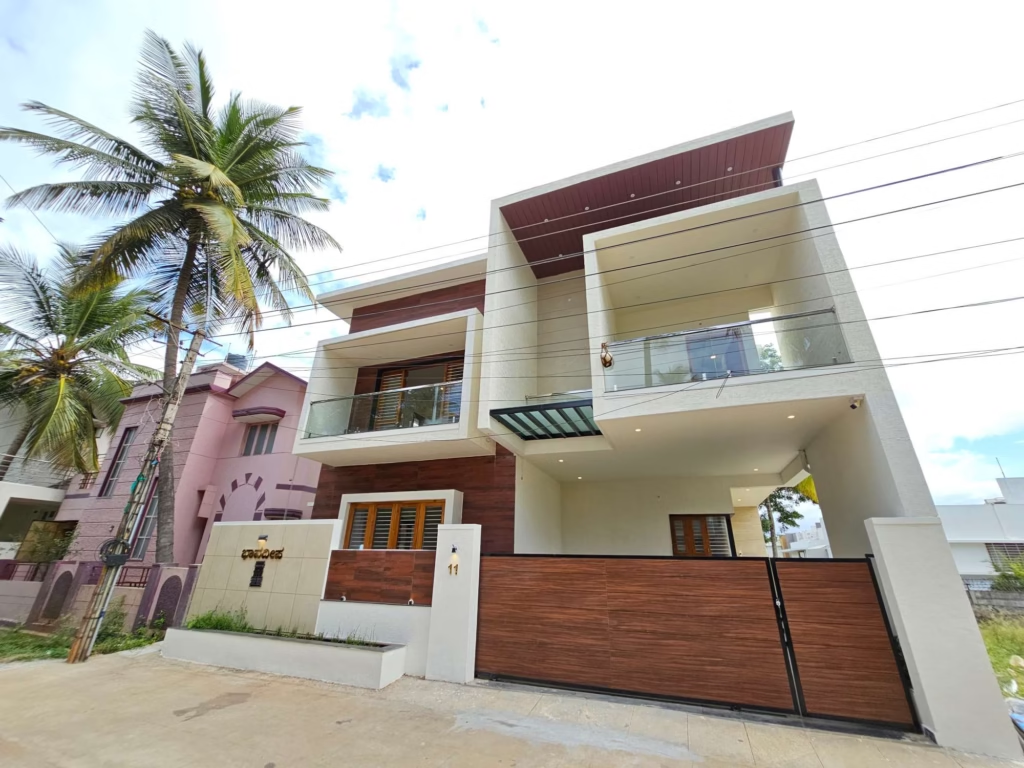
In early 2025, a family from Vijayanagar, Mysore came to Zenith Construction with a brief that most homebuilders in the city had heard before — but few had truly delivered on.
They owned a 30×40 site in one of Mysore’s most established and sought-after residential layouts. They had a clear vision: a modern, well-built 3BHK independent home that would serve their growing family for decades. They had a realistic budget. And they had already been burned once — a previous builder had taken an advance, done substandard foundation work, and disappeared six months into the project.
They came to Zenith Construction looking for something they had struggled to find elsewhere: a builder they could actually trust.
This is the story of that home — from the first consultation to the final handover. Every design decision. Every material choice. Every cost. And every lesson that other homeowners in Mysore can take from this project.
The Client Brief — What the Family Wanted
Before a single drawing was made or a single brick was ordered, Zenith Construction’s team spent time understanding exactly what this family needed — not just what they thought they wanted.
The family:
A couple in their early 40s with two children. The husband worked with a private firm in Mysore. The wife ran a home-based business. Both sets of parents visited frequently and stayed for extended periods.
What they needed:
- A 3BHK layout with one ground-floor bedroom specifically for elderly parents — no stairs required for day-to-day living
- A dedicated work-from-home room for the wife’s business that could also serve as a study
- A spacious kitchen with direct access to the utility area
- Natural light in every room — the previous house they had lived in was dark and poorly ventilated
- An elevation that looked modern and premium but did not feel over-designed or maintenance-heavy
- Total budget: ₹48 to ₹55 lakhs all-in, including design, approvals, and finishing
What they did NOT want:
- Any design elements that would require expensive maintenance
- Substandard materials hidden behind good surface finishes
- A builder who disappeared after taking money
These requirements shaped every decision that followed.
The Site — Vijayanagar, Mysore
Plot dimensions: 30 feet x 40 feet (1200 sqft plot area)
Location: C-Block, Vijayanagar, Mysuru
Orientation: East-facing plot
Zone: Residential — MUDA approved layout
Existing conditions: Flat site, good road access, all utilities available
Vijayanagar is one of Mysore’s most established residential zones. Well-maintained roads, proximity to schools, hospitals, and markets, and a strong community of middle and upper-middle-income families make it one of the highest-demand areas for independent house construction in the city.
The east-facing orientation of this particular plot was an advantage — it allowed the design team to maximise morning sunlight into the living areas and kitchen while keeping the bedrooms on the west side comfortably shaded during the afternoon.
Soil test results:
Before any design work began, Zenith Construction conducted a soil bearing capacity test on the site. Soil bearing capacity: 18 tonnes per square metre — adequate for a G+1 structure with standard isolated footings. No raft foundation required. This saved the client approximately ₹1.8 to ₹2.2 lakhs compared to what a raft foundation would have cost.
Part 1: Design and Planning Phase
Duration: 3 weeks
Team: Zenith Construction in-house architect + structural engineer
Floor Plan Design
The design challenge on a 30×40 site is real. You have 1200 sqft of plot area. Once you account for setbacks — 3 feet on all sides as per MUDA residential guidelines for this zone — the permissible built-up footprint on the ground floor is approximately 750 to 800 sqft.
Fitting 3 bedrooms, 2 bathrooms, a living room, dining area, kitchen, utility area, and a work room into this footprint required careful planning.
The Zenith design team’s solution:
Ground Floor (built-up area: 780 sqft):
- Main entrance with foyer — 45 sqft
- Living room — 180 sqft (double-height ceiling provision made for the living area, executed on first floor)
- Dining area — 90 sqft (open to living, separate from kitchen traffic)
- Modular kitchen — 85 sqft with direct access to utility
- Utility area — 40 sqft
- Master bedroom (for parents) — 135 sqft with attached bathroom — ground floor for zero-stair accessibility
- Common bathroom — 35 sqft
- Staircase — 70 sqft
First Floor (built-up area: 660 sqft):
- Master bedroom 2 (primary couple’s bedroom) — 150 sqft with attached bathroom and walk-in wardrobe provision
- Bedroom 3 (children’s bedroom) — 120 sqft
- Work room / study — 90 sqft with north-facing window for consistent diffused light
- Common bathroom — 35 sqft
- First floor sit-out / balcony — 65 sqft
- Passage and landing — 200 sqft
Total built-up area: 1440 sqft (ground + first floor)
Elevation Design
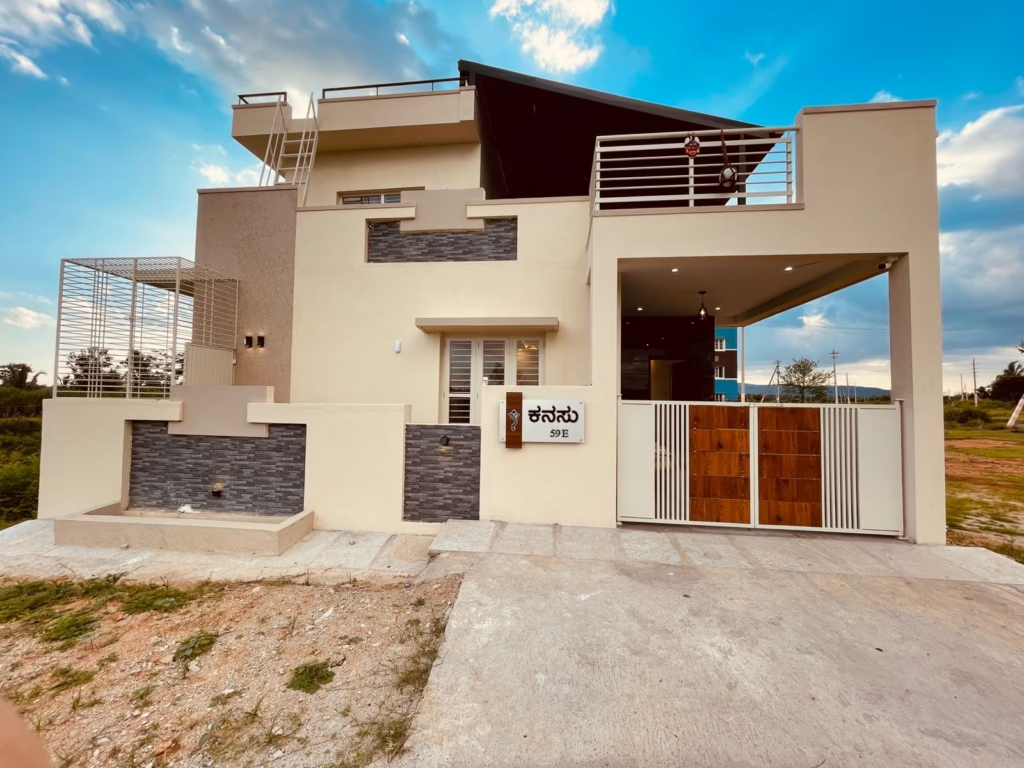
The family wanted a modern, clean elevation without excessive ornamentation. Zenith Construction’s in-house architect proposed a contemporary elevation with:
- Flat roof with a subtle parapet
- Combination of smooth external plaster and exposed brick band at the first floor level
- Aluminium composite panel (ACP) cladding on the main entrance feature wall — a 4×8 feet vertical ACP panel in charcoal grey, giving the elevation a strong visual anchor
- Full-height aluminium sliding windows on the first floor balcony
- Clean horizontal lines created using different surface textures rather than projecting elements — maintenance-free by design
- Covered car parking integrated into the ground floor setback area
The family approved the design after one revision — they asked for the balcony to be slightly wider, which the team accommodated without affecting the structural design.
MUDA Plan Approval
Zenith Construction handled the complete MUDA plan approval process. For a G+1 residential building on a 30×40 site in Vijayanagar, this involved:
- Preparation of building plan as per MUDA bye-laws
- Submission of ownership documents, site plan, and structural drawings
- Payment of development charges and plan approval fees
Total MUDA approval cost: ₹42,000
Timeline for approval: 31 working days
Zenith Construction’s familiarity with the local MUDA approval process — having navigated hundreds of approvals across Mysore’s layouts — meant there were no rejection or revision cycles. First submission, first approval.
Part 2: Material Specification
One of the most important commitments Zenith Construction made to this family was complete material transparency — every specification written into the contract before construction began. Here is the exact material schedule used on this project:
Structural Materials
Cement: Ultratech OPC 53 Grade
Used for: All RCC work including foundation, columns, beams, and roof slab
Reason: Ultratech is one of the most consistently manufactured cements in Karnataka with reliable compressive strength. OPC 53 Grade ensures high early strength — important for Mysore’s climate where construction continues during the pre-monsoon period.
Steel: Vizag Steel Fe500 TMT bars
Used for: All reinforcement — foundation, columns, beams, slabs
Reason: Fe500 grade provides the right balance of yield strength and ductility. Vizag Steel’s traceability and consistent mill test certificates give structural engineers confidence in the specified design capacities.
Concrete Grade: M20 for all RCC structural elements (columns, beams, slabs). M15 for foundation PCC (plain cement concrete).
Aggregate: 20mm and 40mm crushed stone aggregate from quarries near Mysore — shorter supply chain, fresher material, consistent grading.
Sand: River sand for masonry and plastering. M-sand (manufactured sand) used where river sand supply was delayed — with no compromise in quality.
Masonry
Brick type: Fly ash bricks (7.5 x 3.75 x 2.25 inches) — 4-inch partition walls, 9-inch external walls
Reason: Fly ash bricks have better dimensional consistency than red clay bricks, lower water absorption, and better thermal mass — keeping internal temperatures cooler in Mysore’s summer months. They also have a smaller embodied carbon footprint.
Mortar: 1:6 cement:sand ratio for external walls, 1:4 for plaster base coats
Waterproofing
Given the family’s explicit concern about maintenance, Zenith Construction specified a comprehensive waterproofing system:
Roof slab: Dr. Fixit Roofseal — crystalline waterproofing applied to the top surface of the RCC roof slab. 15-year manufacturer warranty.
Bathrooms: Dr. Fixit Pidifin 2K — flexible polymer-modified waterproofing applied to all bathroom floors and walls up to 1.2m height before tiling. This was a non-negotiable specification insisted upon by the Zenith team.
External walls: Cement-based polymer waterproof plaster on all external surfaces.
Underground sump: Crystalline waterproofing internally — prevents both water ingress from outside and leaching of concrete minerals into stored water.
Flooring
Living and dining (ground floor): Kajaria 800x800mm Glossy Vitrified tiles — light cream with subtle veining. Anti-skid coating on the dining area near kitchen.
Bedrooms: Somany 600x600mm Matt Vitrified tiles in warm ivory — matt finish chosen for better grip and cooler surface feel underfoot in Mysore’s summers.
Kitchen: Kajaria 600x600mm Anti-skid tiles in light grey — practical choice for a working kitchen.
Bathrooms: Kajaria 300x600mm digital wall tiles + 300x300mm anti-skid floor tiles
Staircase: Imported Black Galaxy granite treads, 30mm thick — chosen for durability and contrast with the light-toned interior palette.
Parking area: Anti-skid chequered tiles with cement pointing — weather and oil resistant.
Doors and Windows
Main door: Teak wood solid core door, 8 feet height x 3.5 feet width — custom designed with a clean horizontal groove pattern. Fitted with Hafele 3D hinges and Godrej 3-lever lock with digital deadbolt.
Internal doors (bedrooms): Greenply commercial ply flush doors with teak veneer face, 7 feet height. Factory-lacquered finish — scratch and moisture resistant.
Bathroom doors: WPC (Wood Plastic Composite) doors — 100% waterproof, zero swelling in humid conditions. Practical choice that many Mysore builders skip.
Windows: UPVC 5-chamber profile windows — single sliding with mosquito mesh provision. Fenesta brand. All bedrooms fitted with 4×4 feet windows. Living room with 5×4 feet window plus 3×4 feet ventilator above.
Electrical
Wiring: Polycab FR (flame retardant) copper wiring — 2.5 sqmm for power points, 1.5 sqmm for lighting circuits, 4 sqmm for AC and geyser circuits.
Switches and sockets: Legrand Myrius modular switches throughout — mid-premium range chosen for reliability, availability of spares, and clean aesthetic.
Distribution board: Legrand 4-way main DB on ground floor + 4-way sub-DB on first floor. MCB protection on all circuits. ELCB for all bathroom and outdoor circuits.
Provisions made: AC power points in all bedrooms and living room. Geyser points in both attached bathrooms. CCTV conduit from main gate to all four corners. Solar panel provision on terrace (conduit and dedicated wiring to DB).
Plumbing
Water supply: CPVC pipes (Astral brand) for hot and cold water supply throughout. Hot water supply lines from both geysers to all bathroom fixtures.
Drainage: UPVC pipes (Prince brand) for all drainage including soil, waste, and vent lines.
Underground sump: 12,000 litres capacity RCC sump — sized for 3 to 4 days of household storage with a family of 6.
Overhead tank: 2000-litre HDPE Sintex tank with auto float valve.
Bathroom fixtures:
- Master bedroom (parents): Parryware wall-mounted wash basin, Parryware EWC with concealed cistern
- Primary couple’s bedroom: Cera wash basin, Cera EWC with concealed cistern and health faucet
- Children’s / common bathrooms: Parryware standard fixtures
Kitchen: Franke SS 2-bowl sink with drain board. Separate filtered water point provision.
Painting
Interior walls: Asian Paints Royale Aspira — premium washable emulsion with anti-bacterial properties. Two coats over primer.
Exterior: Asian Paints Apex Ultima Protek — exterior weather-shield emulsion with 7-year manufacturer warranty against weathering. Applied in two coats over alkali-resistant primer.
Ceiling: White ceiling paint — Birla White Shaktiman two coats.
Colour scheme: The family chose a warm off-white palette for all interior walls with a single accent wall in the living room (deep teal, Benjamin Moore equivalent matched by Asian Paints). Exterior in light beige with white trim and charcoal ACP feature wall.
Part 3: Construction Timeline
Foundation start date: March 2025
Handover date: November 2025
Total duration: 8 months and 12 days
| Phase | Activity | Duration |
|---|---|---|
| Phase 1 | Site preparation, excavation, soil test | 1 week |
| Phase 2 | Foundation — PCC, reinforcement, concrete | 3 weeks |
| Phase 3 | Ground floor columns and plinth beams | 2 weeks |
| Phase 4 | Ground floor brick masonry | 3 weeks |
| Phase 5 | Ground floor RCC slab and first floor columns | 4 weeks |
| Phase 6 | First floor brick masonry | 3 weeks |
| Phase 7 | Roof slab, parapet, staircase | 3 weeks |
| Phase 8 | External and internal plastering | 5 weeks |
| Phase 9 | Waterproofing — roof, bathrooms, sump | 2 weeks |
| Phase 10 | Flooring — all areas | 3 weeks |
| Phase 11 | Doors, windows, grills | 2 weeks |
| Phase 12 | Electrical rough-in and fixtures | 3 weeks |
| Phase 13 | Plumbing rough-in and fixtures | 2 weeks |
| Phase 14 | False ceiling — living room and master bedroom | 1 week |
| Phase 15 | Painting — primer, putty, finish coats | 4 weeks |
| Phase 16 | Kitchen platform and modular fittings | 2 weeks |
| Phase 17 | Compound wall, gate, driveway | 2 weeks |
| Phase 18 | Final cleaning, snagging, defect rectification | 2 weeks |
Key milestone: The monsoon (July–August 2025) did not cause any delay because the roof slab was completed by late June 2025. All interior work continued through the monsoon months without interruption — a result of careful scheduling by the project management team.
Delay: One 8-day delay occurred in Phase 9 (waterproofing) due to unseasonably heavy early rains that prevented the required dry conditions for the Dr. Fixit Roofseal application. The delay was communicated to the client immediately and did not affect the overall project completion date because it was absorbed within the project’s built-in buffer.
Part 4: Complete Cost Breakdown
The family had a budget of ₹48 to ₹55 lakhs. Here is the complete, actual cost breakdown of this project:
| Cost Head | Actual Cost |
|---|---|
| MUDA plan approval and fees | ₹42,000 |
| Soil test | ₹9,500 |
| Foundation and substructure | ₹4,20,000 |
| RCC frame — columns, beams, slabs (both floors) | ₹10,80,000 |
| Brick masonry — both floors | ₹3,20,000 |
| Plastering — internal and external | ₹2,40,000 |
| Waterproofing — roof, bathrooms, sump | ₹1,35,000 |
| Flooring — all areas including staircase | ₹3,80,000 |
| Main door (teak, custom) | ₹55,000 |
| Internal doors — 6 doors (WPC bathrooms, ply bedrooms) | ₹1,20,000 |
| Windows — UPVC, all 14 windows | ₹1,85,000 |
| Electrical — complete (wiring, DB, fixtures, switches) | ₹1,95,000 |
| Plumbing — complete (pipes, sump, OHT, fixtures) | ₹2,10,000 |
| False ceiling — living room, master bedroom 2 | ₹65,000 |
| Painting — interior and exterior complete | ₹2,20,000 |
| Modular kitchen — mid-range (acrylic finish shutters) | ₹2,80,000 |
| ACP cladding — entrance feature wall | ₹35,000 |
| Compound wall — 3 sides, 5 feet height | ₹1,20,000 |
| MS gate — fabricated, powder coated | ₹28,000 |
| Driveway — interlocking paver blocks | ₹42,000 |
| Overhead tank platform | ₹18,000 |
| Landscaping — front yard basic | ₹22,000 |
| Architect and structural design fees (in-house Zenith) | Included in package |
| Project management (in-house Zenith) | Included in package |
| Miscellaneous and contingency | ₹95,000 |
| Total Project Cost | ₹43,16,500 |
Final cost per sqft (on 1440 sqft built-up area): ₹2,997 per sqft
The project came in ₹4.83 to ₹11.83 lakhs below the client’s stated budget — a result of disciplined project management, no design changes mid-construction, and transparent procurement without middleman markups.
The money saved — ₹4.83 lakhs at the lower estimate — was used by the family to furnish the home, add a split AC in each bedroom, and purchase a geyser for the parents’ bathroom that had not been in the original budget.
Part 5: Challenges and How They Were Solved
Challenge 1: Utility room placement vs. kitchen workflow
During the planning phase, the initial design placed the utility area at the rear of the ground floor, requiring the homeowner to walk through the dining area to access it from the kitchen. The client’s wife — who manages the home and runs a business — flagged this during the design review.
Solution: The Zenith architect redesigned the kitchen layout to create a direct pass-through door between the kitchen and utility. This required moving one column provision by 8 inches — a structural adjustment that the in-house structural engineer handled without any cost change to the client. The result is a kitchen-utility flow that makes daily household work significantly more efficient.
Challenge 2: Parents’ bedroom — privacy vs. accessibility balance
The ground floor bedroom for the parents needed to be accessible from the main entrance without going through the living room — the elderly mother had limited mobility. But it also needed privacy from the rest of the house.
Solution: A short secondary passage was created adjacent to the foyer, giving the parents’ bedroom direct access from the entrance without going through the living space. The passage also doubled as a small storage area with built-in shelving — a practical addition that added no structural cost.
Challenge 3: North-facing work room light — Mysore summer conditions
The wife’s work room was designed with north-facing windows for consistent diffused light. However, during construction, the team noticed that an adjacent compound wall on the north side of the site would significantly reduce light entry during morning hours.
Solution: The window height was increased from standard 4 feet to 5 feet, and a high-level ventilator window was added above the main window. A light-coloured reflective paint was applied to the section of the compound wall visible from the work room. The result is a bright, glare-free work environment that the client now describes as the best room in the house.
Challenge 4: Budget pressure at finishing stage
At the flooring selection stage, the client was initially drawn to larger format 1200x600mm tiles that were ₹55 more per sqft than the specified 800x800mm tiles. Over 1440 sqft, this would have added ₹79,200 to the budget — pushing them past their upper limit.
Solution: The Zenith team proposed a compromise — larger format tiles in the living room only (approximately 180 sqft), maintaining the standard tile specification in all other areas. The visual impact of the larger tiles in the living room was maximised while the additional cost was limited to ₹9,900. The client was delighted with the result and the savings.
Part 6: What the Finished Home Looks Like
Ground floor on completion:
Walking through the main entrance, the first thing visitors notice is the double-height living room ceiling — even though the first floor is fully built, the living area benefits from a visual height that most 30×40 homes in Mysore do not have. The teak wood main door, the ACP feature wall on the right, and the large format tiles underfoot create an immediate impression of quality that was not expensive to achieve but was carefully designed.
The parents’ bedroom opens directly from the foyer passage — functional, private, and accessible. The common bathroom adjacent to it is sized for easy use by elderly users, with grab bar provisions built into the wall structure.
The kitchen is the wife’s domain and it shows — a clean, functional workspace with a 10-foot granite-top modular kitchen, direct access to the utility, and a window above the sink that looks into the east-facing front yard.
First floor on completion:
The primary couple’s bedroom is the largest room in the house — 150 sqft with a false ceiling featuring indirect lighting and a dedicated walk-in wardrobe area. The attached bathroom with concealed cistern and health faucet is a significant upgrade from the standard bathroom fittings the couple had lived with in their previous rental home.
The work room faces north and is lined with custom-made floor-to-ceiling shelving on one wall — built by a local carpenter using Greenply ply and white laminate, organised entirely by the wife’s brief. It doubles as a small meeting space when needed.
The balcony on the first floor faces east — morning coffee overlooking Vijayanagar’s tree-lined streets is now a daily ritual for the family.
Part 7: Client Feedback — In Their Own Words
At the handover in November 2025, Zenith Construction asked the family to share their experience. Here is what they said:
On the process:
“We had a very bad experience with our previous builder. With Zenith, from the first meeting, everything was different. Every payment we made was against a milestone. Every material that arrived at the site was the brand that was in our contract. When there were problems — and there were a couple — we were told immediately and given solutions. Not excuses.”
On the design:
“The work room was the best surprise. We told them we needed good light for my work and that was it. What they designed and built is something I could not have imagined from a brief description. It is the room I spend 8 hours a day in and I love it.”
On the cost:
“We were told ₹43 lakhs. We paid ₹43 lakhs. Not ₹43 lakhs and then ‘electrical is extra’ or ‘the tiles you chose cost more.’ Everything that was in the contract was done. Everything that came up that was new was discussed first.”
On Vijayanagar as a location:
“We were already living in Vijayanagar when we started this project. The location chose us as much as we chose it. The roads are good, the neighbours are good people, and the house has appreciated already. Three families on the same street have asked us who built our house.”
Part 8: What This Project Cost Compared to Market Rates
A 30×40 G+1 house with 1440 sqft of built-up area in Mysore in 2025 built to this specification would typically cost:
Self-managed with separate vendors:
- Separate architect: ₹40,000 to ₹60,000
- Separate structural engineer: ₹25,000 to ₹35,000
- Labour contractor for structure only: ₹18 to ₹22 lakhs
- Materials procured by client at retail: 15 to 20% premium on market rates
- Interior contractor: ₹8 to ₹12 lakhs
- Coordination losses, rework, delays: ₹3 to ₹8 lakhs
- Estimated total: ₹50 to ₹62 lakhs
With Zenith Construction (full-service):
- Architecture, structure, construction, interior, PM — all included
- Materials procured at bulk contractor rates
- Zero rework on this project
- Actual total: ₹43.16 lakhs
The difference: ₹7 to ₹19 lakhs saved versus self-management — plus 8 months of stress that the family did not have to carry.
Part 9: Why Vijayanagar Is One of the Best Areas to Build in Mysore
This project reinforced what Zenith Construction has known from years of building across Mysore’s layouts — Vijayanagar is consistently one of the strongest choices for independent house construction in the city.
Established infrastructure: Roads, drainage, electricity supply, and water connections in Vijayanagar are all mature and reliable. This matters enormously during construction — site access for material delivery, water supply for construction, and power for power tools are all non-issues in this layout.
Strong appreciation: Property values in Vijayanagar have appreciated consistently. The family’s completed home has already been informally valued by a real estate agent at ₹78 to ₹82 lakhs — a significant premium over the ₹43.16 lakh construction cost plus the cost of the plot.
Community quality: Vijayanagar attracts established families and professionals. The social environment is stable, well-maintained, and community-oriented.
Proximity to everything: The layout is within 15 minutes of Mysore’s major hospitals, schools, markets, and commercial centres. It is also well-connected to the Mysore-Bangalore highway for the growing number of professionals who commute between the two cities.
Resale and rental value: If the family ever chose to rent the first floor while living on the ground floor, rental income in Vijayanagar for a well-finished 2-bedroom floor would be ₹15,000 to ₹22,000 per month. The home is an asset, not just a residence.
Key Takeaways for Homeowners Planning to Build in Mysore
1. A soil test is not optional. This project saved ₹2 lakhs by confirming good soil bearing capacity before foundation design. Had the design assumed poor soil and specified a raft foundation, that money was wasted. A soil test costs ₹8,000 to ₹15,000 and is always worth it.
2. Specify your materials before you sign. Every material in this project — cement brand, steel grade, tile brand, electrical fittings, plumbing pipe brand — was in the contract before construction began. This is what prevented any mid-project substitution or surprise cost escalation.
3. Design for your actual life, not a showroom. The work room and the parents’ ground-floor accessible suite were designed around specific needs of this specific family. They would not have been in a standard 3BHK template. The first conversation with your builder should be about how you live, not what you want the house to look like.
4. A full-service builder is usually cheaper than self-management. This project saved ₹7 to ₹19 lakhs compared to the self-managed alternative. The coordination, procurement scale, and zero-rework track record of an experienced builder like Zenith Construction translate directly into rupee savings.
5. Budget for external works from the start. The compound wall, gate, driveway, and landscaping cost ₹2.12 lakhs. Many homeowners forget these entirely until the house is complete and then scramble for additional budget. Build it in from day one.
6. Vijayanagar rewards good construction. The appreciation on this home validates the quality investment. A well-built house in a strong layout is not just a place to live — it is one of the best financial decisions a Mysore family can make.
Could Zenith Construction Build Your Home in Mysore?
This project is one of hundreds that Zenith Construction has delivered across Mysore and Bangalore. Every project is different. Every family is different. Every site has its own conditions and constraints.
What does not change is the approach — complete transparency on materials, pricing, and timeline. A single point of accountability for design, structure, construction, and finishing. And an honest conversation at the beginning that gives every client a realistic picture of what their home will cost, how long it will take, and exactly what they will get.
If you are planning to build in Vijayanagar, or anywhere else in Mysore and Bangalore, the best first step is the same one this family took — a free consultation with the Zenith Construction team.
No commitment. No pressure. Just an honest conversation about your project.
Book Your Free Consultation with Zenith Construction
Zenith Construction — Starting at ₹1999/Sqft Including GST
📞 Call: 961-118-4850 / 991-619-3939
📧 Email: info@zenithconstruction.in
📍 Address: #378, Prakash Complex, 2nd Floor, Akkamahadevi Rd, C-Block, JP Nagar, Mysuru – 570008
🌐 Website: zenithconstruction.in
Serving Mysore, Vijayanagar, Vijayanagar Extension, JP Nagar, Kuvempunagar, Hebbal, Bogadi, Srirampura, Bangalore, and surrounding areas. 11+ years. 500+ projects. Zero hidden charges.